
Blog

Take up thy bed and Work

The first time I heard the term ‘worklessness’ I remember a shiver running down my spine- it was the way in which it was being used to describe an apparent ‘human condition’ in which there was a sense of this being a lifestyle choice. We were told that it meant not simply being ‘unemployed’ but not actively seeking and/or being available for work; but it was not applied to the idle rich or others members of society, myself now included, who have concluded that work is not particularly good for their health but do not need to claim benefits (although my University Pension, funded partly through the state is still a benefit). At a time when the drive towards viewing employment as the desired outcome for people with mental illness was beginning to take precedence over other more used-centred outcomes it was a prescient warning of changes about which we are now only too aware- the move to treat people with physical but also particularly mental health problems as essentially capable of taking up their own beds and walking to the Job Centre, regardless of their condition.

I’m very suspicious of terms that are used by governments to describe those who do not comply with what is expected of them in our societies. As a psychiatrist I have been accused of being an agent of the state on more than one occasion, but the role played by British psychiatrists is a long way from that which was played by Nazi psychiatrists in the Third Reich who colluded in ‘euthanasia’ or by the psychiatrists in the Soviet Union who were willing to label political dissidents with the diagnosis of ‘sluggish schizophrenia’- which resulted in the expulsion of their organization from the World Psychiatric Association. The use of diagnoses to both label and treat dissident citizens continues to this day- for example in the controversial treatment in China of the practitioners of the Falun Gong meditation movement who are deemed to be psychotic and undergo ‘treatment’. We have also recently seen the notorious collusion between psychologists in the USA and torture of detainees at Guantanamo Bay. Professionals who were willing to behave unethically in the service of the state for payment.

You may say these are extreme examples, but I think we should be concerned when political and social issues are described in terms which a) infer that the problem lies within the individual rather than society b) dresses this up in pseudo-psychological terminology and c) infers that there is a treatment, psychological and/or physical for this.

The report this week from Birkbeck College highlighted the way in which being unemployed is increasingly described in policy documents as a problem of the individual, who lacks motivation or the ‘right attitude’ to obtain a job. This is deemed to be ‘treatable’, although for a professional to engage in such enforced treatment, without which a person will lose his or her benefits has been described as ‘not only unethical but probably illegal’.

It’s difficult to see how a person with severe mental illness would be capable of acquiring the ‘right attitude’ when they are still struggling with the everyday tasks of life. Yet there are people in our government who clearly think this is possible, which is not only senseless but very, very scary. It reminds me of the attitude of some of the people I worked with over the years, who truly seemed to believe that mental illness is itself a ‘lifestyle choice’, which the person suffering not only had power over, but could choose to change if only they wanted to do so. An attitude which not only lacks basic empathy, but has a seductive simplicity which has emerged recently in the imperative to declare oneself ‘well’ and ‘recovered’, and has been around for many years in some so-called ‘self-help books which tell you that you can ‘climb out of your prison’ without any help in unlocking the door.

It’s a worrying trend in a society, which seems not only to care less than ever for those who have disabilities but to declare that a person has, within him or herself, the power to overcome their problems, if they choose to, and obtain a job with or without the aid of some motivational therapy. And what happens if they don’t take up their beds and work? The Rt Honourable Ian Duncan Smith would seem to believe they must work, because it is in itself a form of treatment. For as it famously said on the gates of Auschwitz, Arbeit macht frei ‘Work Sets You Free.’

Nothing like the common cold

Everyone disapproves of stigma, and yet that doesn’t seem to have had an impact on the way in which mental health professional themselves continue to stigmatize those with mental health problems. At this point I can hear all the professionals reading this saying ‘but I don’t do that,’ and indeed you (singular) may not. Yet those of us within the professions who have been mentally ill have experienced it. Mental illness is still something that happens to other people, but not to people like us.

A good friend of mine, Maureen Deacon, died this spring. She had been a Professor of Mental Health before taking her retirement, and I first met her more than thirty years ago when she was the ward sister in the Professorial Unit at Withington Hospital in Manchester and I was a Senior Registrar in the ward downstairs from hers. We had several friends in common and kept in touch over the years. I also knew her partner very well. In the early 1990’s Maureen persuaded me to recklessly join her on an overland bus journey from Manchester Piccadilly to Leningrad as it then was, which took 4 days in each direction. I remember someone getting on and asking if it was the Blackpool bus, and we all shouted ‘No, Leningrad’ to the interloper’s complete bemusement. You bond with someone when you both eat nothing but hummus and pitta: the only food you have brought with you for the journey, day in, day out. We hadn’t seen so much of each other in the last few years but we continued to meet every now and then for dinner and chat with our respective partners and to see each others’ feline companions.

Maureen had been unwell with cancer for some time. I wasn’t able to attend her funeral because I was in Orkney then, but I know she wanted everyone to dress in bright colours for her farewell, and not come in black. She was always very upbeat, hard-working, utterly reliable and a great friend. I also knew she had been depressed, both before and after her diagnosis with cancer. She never said much about it, but we talked briefly on occasions about what it felt like and taking antidepressants. She knew I had been unwell on occasions too. So it was a shock for me to read in the paper she completed just before her death, and published this month in the Journal of Psychiatric and Mental Health Nursing, that she had experienced six episodes of depression, and had seriously considered suicide during at least one of these. I’m ashamed I never picked up how bad things had been for her, but as she said in this personal account of her experience ‘I was an expert at hiding it.’

She wrote :‘being depressed is worse than having advanced cancer’ and at that time she had a life-limiting illness. She was acutely aware of the stigma that depression carries. This, she said, had two aspects. The self-stigma that is experienced by those of us who get depressed:

“…I tend to see my mood disorder as a character flaw-evidence of my weak and neurotic nature. Currently this is reinforced (for me) by the interest in mental health and resilience, clearly something I’m missing, in some sense at least. Secondly there is the guilt and worthlessness hat comes along for me with depression experience: ‘I should not feel like this I have a blessed life, a partner who loves me, a lovely home…’”


But also the stigma that depression carries, perhaps more so than ever, within mental health services in the UK. Even severe depression is not deemed to be serious enough for mental health nurses, working with Community Mental Health Teams, to be involved in the care of, except if the person is suicidal- and even then only for a limited amount of time. Depression, Maureen said, has been called one of the ‘coughs and colds of psychiatry’ and I’ve called out junior doctors for referring to anyone not under the care of mental health services who is anxious or depressed as the ‘worried well’. This kind of language doesn’t help the mental health professional in their company, quietly keeping their own counsel or indeed anyone with depression to feel any better about themselves. Diminishing their experience does not speed their recovery and discourages them from seeking help. When I was well such attitudes made me angry, but when I was unwell it certainly deterred me for a long time from publicly admitting I had any problems at all.

During my time as a consultant I saw and treated many nurses with mental health problems- students, mental health nurses, general nurses, ward sisters. After the case of Beverely Allitt, the nurse who murdered several children in a paediatric ward, I remember trying to help a seriously depressed young woman who was petrified that having treatment for depression would mean she was thrown off the general nursing course. There seemed, from her point of view, to be very little distinction being made between having treatable mental illness and potential psychopathy by her course directors. This was her understanding, but I would not be surprised if she was right. I’ve met health service managers with similar difficulty in grasping what mental illness actually is, how it affects a person, and how a person who suffers from it is more at risk of harm from others than vice versa. I’ve also seen mental illness treated very differently from physical illness by some managers. I was asked for information about a ward sister who was an in-patient on my ward through the inter-organisational route, following conversations between hospital managers, which was a blatant attempt to breach my patient’s confidentiality. Would this have happened ifshe had been receiving care for a physical illness? When I personally made my first very tentative visit back to unit I was working on when I had been off sick with severe depression, I received a letter from the Personnel manager a couple of days later, saying ‘You looked well. I hope this means you are returning to work soon?’

As Maureen said in her paper:

‘the sheer terror of work colleagues knowing I was unwell was enough to get me moving. Ironically, on the two occasions I was persuaded to take sick leave, I got better much more quickly’.

Reading her account fills me both with admiration…and regret. How I wish we had been able to talk more about how she was feeling, but she didn’t feel able to, and I never picked up the cues.

I will always miss her quiet wisdom and common sense.

Her conclusion was that, to really understand stigma as mental health professionals we have to get away from thinking mental illness is something that happens to other people . Not to us who are always resilient, invulnerable, immune to stress, and as a result far too ashamed to admit when we experiencing something which I can assure you is far from having something like a common cold.

Reference

Deacon M. Personal Experience: being depressed in worse than having advanced cancer. Journal of Psychiatric and mental Health Nursing, 2015,22,457-459.

Reclaiming the past

What is it about a song that it suddenly transports you back to another time and place, and evokes all the different emotions associated with it? There are some places in the recesses of my memory that I’ve haven’t visited for a very long time. I’ve not experienced major trauma in my life, unlike some of the people I met when I was a practicing clinician, but I’ve still locked places, events, moments, away in the corners of my mind and every now and then something triggers them back into my consciousness.

I was at a concert the other evening when I heard an old Scottish folk song I hadn’t sung since my childhood. Suddenly I was transported into the past. I hadn’t thought about it in years but I could remember singing it at school, and at home with my mother, who loved singing too. We often sang at home- it was probably the only time my mother and I were ever in harmony.

The feelings stirred up by those ten minutes of music have stayed with me all week. I’ve been dreaming again about my childhood when I’ve not done that for some time. There are some things I want to recall, and others I don’t but my mind seems to want to churn away at those memories until I’ve unlocked a few more dusty cabinets in my brain and rifled though them. It’s at the very least a disconcerting feeling, yet it doesn’t stop me brooding on it.

Repressing memories and the feelings they arouse is something everyone does, but some of us do it more than others. I know why I do it. I’ve managed some difficult times by packing away memories and the people and places associated with them. It’s remarkably easy to do. You simply move on and start again, promising yourself that you will get in touch with the friend who has been bereaved but to whom you find it hard to talk because it evokes too many memories of losing people who have been important to you; go back to the place you lived at a complicated time in your life when both wonderful and awful things happened to you, because you cannot face dealing with those emotions again- so you lose touch with all the people you knew there. It’s just too painful so you avoid it. You don’t go back.

The danger of doing this repeatedly is that you can become almost a person without a past- and that isn’t only a potentially lonely place to be. It also means you cannot always be sure who you really are. You tear up your roots each time you move on leaving little trace behind, either where you have been, or in your conscious memories. Or at least that’s how it’s been for me. Sometimes I find it difficult to make any sense of my life because for many years I almost never returned to anywhere associated with the past. This included my childhood home, place I visited in my youth, even the city where I went to university. For more than two decades I avoided going back to the town in which I spent the first 18 years of my life. What I do know is that it’s not easy to exorcise ghosts, but it is possible. A consequence of psychotherapy was that I was able to do quite a lot of this emotional work, its just not complete yet. I’ve been able to revisit many of these places in recent years, but it still doesn’t feel like I’ve completely reclaimed them, and allowed myself to acknowledge their importance in my past. I’m not entirely sure why.

And the Scottish folk song? It was Charlie is my darling sung by Eddie Reader in concert with the Scottish National Jazz Orchestra, although she performed it with the more racy lyrics written by Robert Burns than the version I remembered. My mother was Scottish, and when I was a child in England I was very conscious, and proud, of being half Scottish and half English. We visited Scotland on holiday, but not the part that I live in now in Orkney, or the tourist routes of Highlands with the views I still associate more with the pictures on tins of shortbread than reality. We went to North Lanarkshire, where my grandfather had been a miner, and my uncle a steelworker at Ravenscraig. I shared a bed with two of my cousins in the overcrowded house in which they lived on the Whitehill estate- which has the dubious reputation of being one of the first places in Britain to impose a youth curfew, to try and get children off the streets at night. It wasn’t pretty, and I was always aware I didn’t fit in somehow. I didn’t speak with the same accent, didn’t have (quite) the same approach to alcohol and I wasn’t at all preoccupied with whether you wore blue or green on a Saturday. I wasn’t used to knowing who was a protestant and who was a catholic in your street like my cousins were. But I am aware that my grandfather, who I never knew, belonged to the local Orange Lodge. He was active in that sectarian tradition of central Scotland that I totally abhor. And when my relationship with my mother deteriorated to the point that we cut off contact, it became somehow harder than ever to feel an affinity with the place of her birth. But if there are Scottish genes in me, that’s where they come from. I still feel a bond with Scotland. I went to university there. I’ve travelled all over it. I was even married to a Scotsman- for a while and I live there some of the time now. But at the same time, it sometimes feels like I can’t really claim an honest connection because that part of my early life that provides a tangible link has been locked away. I haven’t really dealt with it because isn’t ‘me’.

A couple of years ago, I travelled to Glasgow by train for the first time in 30 years to examine a PhD student, and was suddenly and powerfully transported into the past as I walked out through the concourse of Glasgow Central. I remembered going into the city for the day on the train in the 1960s, across areas that were almost derelict and due for demolition. For someone from the rural east of England, it was like travelling through another universe. I’ve driven up the M74 many times, past the exit for Hamilton, and all the signs for the places that remind me of day trips in my childhood. But I’ve never been back to where my family comes from. I’ve lost touch with both family and place and in doing so I’ve cut out another part of my life.

Perhaps the real message of the song for me was it’s time for me to revisit the place that evokes those memories, if not the people. It’s far too late for the latter and I doubt I would ever be welcome. But I need to reclaim the past, to reconcile myself a little more with who I am and where I come from- while I still can.

Two units under

According to my other half, I am one of those people who are permanently short of two units of alcohol. I’m undoubtedly better company when slightly I’m under the influence- I’m more sociable and relaxed. I can engage in conversation without feeling self-conscious when I’m with people I don’t know well, or haven’t seen for a while. Life just flows more easily. Two units a day, you say, that isn’t very much, its 14 a week, that’s just on the ‘safe limit’ for women. So why have I been trying to reduce the amount that I drink?

Since my early 20s I’ve been aware that I have an ambivalent relationship with alcohol. Most of the time we remain on reasonably good terms, but when my mood is low, or I’m under stress the booze likes to get one up on me. Like many people, when I was working full-time, I began to rely a little too much on my liquid friend. Days began to be measured on a new scale of severity- the number of bottles of Stella Artois I needed to feel relaxed after a weekday in the real world. One bottle (330ml 2 units) was a normal dosage, two bottles (4 units) for a tough day and 3 bottles (6 units- thankfully not very often) for a bloody awful day, plus a very strong Martini on Friday night to decompress and sometimes again on a Saturday, and wine (3-4 glasses) over the weekend. Mostly I drank just about up to the limit. Sometimes, and increasingly so as time went by, I exceeded it.

Okay, I can hear you saying, ‘what are you worried about, I know loads of people who drink a lot more than that!’ You may even do so yourself. I’m not asking you to consider it that is of course your choice. But it’s not only the amount you consume (although most diseases related to alcohol haven’t been informed there are ‘safe’ limits, the risk just gets greater the more you drink) it’s the nature of the relationship you have with booze. It’s addressing why you sometimes feel the need to rely on a friend whose apparent affability, social and legal acceptability masks the risk it poses for those of us who have the potential to depend on it, not just emotionally but physically too if we drink long and hard enough. Earlier this year, when I was experiencing, for a while, the most severe physical symptoms of anxiety I have ever known, when my chest was permanently tight and my hands shaking, there was only one substance easily accessible that took those symptoms away, and it usually took one of my husband’s martinis which is a fairly lethal combination of gin and vodka (plus Lillet Blanc and a twist of lemon if you are interested) to help me feel anything like calm. Mindfulness exercises didn’t touch it. Exercise was difficult as I felt exhausted most of the time and too anxious to venture out much. I’m quite sure diazepam would have worked too, but I’ve spent so many years trying to help people withdraw from it I wouldn’t wish to take it. I remember one of my patients who was depressed and couldn’t sleep said to me. ‘I didn’t want to take any pills, so I just decided to try alcohol, it’s a natural remedy isn’t it? Well no, it’s about as natural as anything that’s been processed by a brewery or distillery can be I suppose. And the Distiller’s Company also gave us thalidomide too. Not that I am any way comparing alcohol with that particular drug, but we know it also can cause terrible damage to the unborn. Alcohol is acceptable, available and costs comparatively less than it used to when you buy it in bulk at the supermarket or in Happy Hour.

When I worked as a consultant in a substance misuse service I saw so many young men whose problems with alcohol had begun in their teens, when they drank to self-medicate for social anxiety, unable to approach a member of the opposite sex when completely sober. The problem is alcohol doesn’t only relax you, it lowers your inhibitions in other ways. You are more likely to put yourself at risk, for example by having unsafe sex or walking home in the snow with insufficient clothing after a night out risking hypothermia, when you are drunk. Alcohol has a curious relationship with mood disorders that mental health services in the UK (but not in Australia) still don’t pay enough attention to. People with bipolar disorder can drink excessively when they are high and when they are low. Those of us with depression use alcohol to numb the pain of being alive, but the side effect is that we then feel much less inhibited about trying to harm ourselves or end our lives. When I was a student I discovered the advantages and disadvantages of drinking to oblivion. I was in danger of becoming the person we all remember who seemed to go that little bit further than everyone else, and we much later heard was not only emotionally but physically dependent on booze and on their way to destroying their career. Medicine is noted for its relationship with alcohol. There even used to be a bar in the doctors residence in Manchester when I was a junior doctor. I’ve glibly asked students at interview what they do to relax, because ‘medicine is an emotionally taxing profession’, and heard them list all their sporting and musical activities knowing full well how many of us fall back on the nightly Stella because it’s the easy, instant option.

So, of late, I’ve been considering this relationship much more honestly than I have in the past. I’m aware I have within me the potential to spend far too much time with this erstwhile friend and be lead seriously astray, but I’m still ambivalent. l so love the feeling of being intoxicated, at least until I wake in the early hours next morning. But I rarely allow things to go that far now. I’ve been staying alcohol free for longer and longer, particularly when I’m in Scotland. I don’t drink alone in the house, and I can no longer have anything at all when I’m out due to the new drink driving laws. I hope they are having an effect on the overall amount people consume, but we still need legislation on minimum pricing. I learned as a medical student that national consumption was governed by cost and availability. Why is more research required?

I still enjoy the occasional drink but I’m beginning to know, and like, my persona who is always two units under a little better and helping her find other ways to manage her anxiety. It’s a healthier option for me, in the longer term, giving alcohol the brush off.

A life in the NHS

I arrived in this world seven years after the birth of the National Health Service. My life has been framed by it. I was born in a cottage hospital and regularly weighed by the nurse at the district clinic. As I grew I was taken to the General Practitioner who for many years had a surgery attached to the side of his home. I don’t remember much about those visits other than on one occasion my mother took me along expecting the GP to advise her (and me) what should be a reasonable bedtime. I know she was disappointed by his response.
‘She’ll sleep when she’s tired.’
An American psychiatrist I met many years later suggested I may have had ‘Oppositional Defiant Disorder.’ I remember retorting, ‘No I’ve just always been difficult.’ My mother certainly seemed to think so anyway.
When I left school, I studied medicine, and qualified as a doctor and then as a psychiatrist, working in the NHS in Scotland and the North of England for over 30 years. I was, and still am, proud to have been part of the massive social experiment that began the day Aneurin Bevan was symbolically handed a large bunch of keys by the matron of Park Hospital in Davyhulme.

I’ve seen firsthand what life is like in a country where the market governs healthcare. Several years ago I spent a few months studying the American health system as a Harkness Fellow in healthcare policy. A few memories from my time travelling between clinics in Washington State remain with me, indelibly burned into my memory.

• The young woman with poorly controlled asthma stifling her tears because she had to say goodbye to her doctor even though she was not moving away from town. She had changed jobs and her new employers’ insurance system contracted with a different ‘provider’.

• The middle-aged man on the telephone in the waiting room pleading with his friend down the line. ‘Can you lend me some money…I can’t afford to pay for my insulin.’

• The young man in paint splashed overalls who lay flat on the front seat of the bus writhing in agony, getting himself to the Emergency Room by public transport; probably to avoid having to pay for an ambulance he could not afford.

• The general practitioner who told me how she struggled to help a young woman in her clinic who was acutely psychotic. Her basic state medical insurance didn’t cover specialist mental health care, so the visiting psychiatrist, who was in the next office, was unwilling to either see her or advise.

• The nephrologist who specialized in treating African Americans in a southern state with a high prevalence of diabetic renal disease who told me that he could personally ensure his low income patients without health insurance got the care they needed through his academic interest in them, but others would not. He seemed curiously accepting of the status quo. ‘That’s how it is here.’

Don’t get me wrong. The NHS is a complex many-headed beast, fraught with problems. I have not only benefited from it, but I have suffered from it, and seen others do so too. I have struggled with and been bullied by bureaucratic and hostile management and survived an attempt to remove me with some serious consequences for my mental health. I’ve also known visionary managers some of whom became friends. But I’ve also seen the NHS try and fail to entirely abolish traces of the mentality of the huge county asylums it inherited in 1948. I’ve worked with many extraordinarily compassionate and caring practitioners, yet I still hear service users relate examples of attitudes and behaviour towards them, which are all too familiar from my early days as a consultant in a decaying mental hospital.

The gap between physical and mental healthcare, which was wide even when the new district general hospital psychiatric units were attached to the rest of the hospital by long corridors, grew to a chasm with the separation into acute and mental healthcare trusts. Despite evidence that investment in mental health care might have significant impact on the spiraling costs of physical healthcare, the concept of ‘parity’ still seems something to which little more than lip service is paid. Mental health care has been cut by a greater percentage in funding than any other area. And now, with the decline in numbers of GPs and funding of primary care, where 90% of mental health care is provided, we should not be surprised that it is harder than ever for people to get the help they need when they are in acute distress.

Throughout my adult life I’ve been in receipt of mental health care, most of it provided by NHS staff, who went the extra mile even though I wasn’t always easy to help. I’m still and always have been contrary. No one ever suggested it wasn’t in his or her contract to treat me but the goodwill that used to ensure mental health professionals didn’t have to receive treatment in the places where they work has largely disappeared. Rules reminiscent of what I encountered in my times in the USA are becoming increasingly used to determine who gets help.
‘We’re not commissioned to provide care for people with (you name it- Aspergers, Autism, Personality Disorder, Analgaesic abuse….the list grows).’

And now I’m getting older, and I have recently been diagnosed with kidney disease, I know there is a very real possibility I will one day be as dependent (a sorely unfashionable word I know) on the NHS as the day I was born, only this time for dialysis. I’m worried about whether the NHS will exist when I really need it to save my life, or whether I will struggle, as the patients I saw in the USA, to obtain care from an uncaring system.

Last time I visited Park Hospital, now known as Trafford General Hospital, the black and white pictures of the great day the NHS was founded were still on the walls of a corridor in an old part of the building, but clearly forgotten and sorely neglected. Their state seemed to me to represent the ways in which successive governments have tried to forget, suppress or actively derail Bevan’s extraordinary achievement. For all of our sakes let us not sleep walk compliantly into a future when it will suddenly not be there for any of us to depend upon.

In order to do this we must never stop being ‘difficult’. I prefer to call it ‘creatively contrary.’

(Still) taking the tablets

Not so long ago, I asked my current doctor how he thought I would have been over the last 20 years if I hadn’t stayed on antidepressants continually. He said he thought I would have had at the least a period of in-patient care. When I asked my other half, who has known me for nearly 30 years, and remembers life before and after I had medication his response was simple.

‘You would be dead.’

Since I last somewhat reluctantly shared my views on antidepressant medication a year ago, (before that I’d kept my head below the parapet) there has been a continuing debate about them both on twitter, where I’m quite active, and in the media. My blog was paired with an article written by a fellow psychiatrist who has very different views from my own, who told the Daily Mail she wouldn’t take antidepressants even if she were suicidal. I was pleased our contrasting views went out together. Others have questioned me directly with comments such as ‘I can understand why you take them if they’ve helped you, but why do psychiatrists still prescribe them when they don’t work?’ and a little more personally: ‘well you would say they help because you’re a psychiatrist.

When I joined twitter, I expected there would be primarily a view that medication was unhelpful and shouldn’t be prescribed. I guess that’s because that’s the message that the media often seems to prefer. There are several eminent mental health professionals who share this view and write about it frequently. Many of them are involved in the Council for Evidence Based Psychiatry and are active on social media. In fact, what I found, as well as people who share their views, was a substantial section of people who were willingly to talk of how medication has helped them. Some of them, like me, have also had psychological therapies, but many others have unfortunately not been able to access them.

NICE (the National Institute for Health and Clinical Excellence) is about to start a new review of the evidence, but its current advice is that antidepressants should not be used in milder depression, should be offered as option in moderate depression, and should be used in addition to psychological therapy in severe depression. That’s why I prescribed them when I was still practicing and most other psychiatrists and GPs, still do. But unfortunately the difficulty in accessing psychological therapy makes it hard in practice to follow the NICE guidance as we should. Many people do not get offered evidence-based treatment. If this happened in cancer it would be a national scandal, yet untreated depression, as we know too well, not only causes great suffering but can also be lethal. There are people who wouldn’t benefit from antidepressants who end up on them unnecessarily and only experience the side effects. There are others who feel there is no other choice open to them without a long wait. In severe depression, treatment which doesn’t also include psychological therapy is incomplete. Medication alone is never the solution.

I’ve stayed on tablets because, as my doctor and husband agree, I don’t think I could have managed to live the life that I’ve been fortunate to have, if at all. It’s been a productive one, but it hasn’t been easy. I’ve still had relapses: I was unwell earlier this year again and am now recovering. I didn’t cope with work stress well at all, although latterly Cognitive Behaviour Therapy helped me to find new ways to manage that; and I know that I still react badly to loss events. I have a family history of mental illness, and one first degree relative was hospitalized. My early life almost certainly contributed to my susceptibility. I’ve written at much greater length about this in my memoir, which will be published this autumn. However I haven’t been as low or completely unable to function as I was prior to taking medication. Psychotherapy helped me earlier in my life, but couldn’t prevent me having more severe episodes in my mid-thirties. Each time I’ve relapsed, my medication has been changed. Sometimes things have been added in. I’m on a combination now once more. I know there will be people who will say my recoveries are due to the placebo effect, which can be very powerful, but last time, as previously, I’ve begun to recover in the time scale predicted by the evidence. This time it was around 3 to 4 weeks. It certainly was not immediate, in fact as sometimes happens, my mood continued to deteriorate after I started the new treatment.

Medication has some truly vile side effects; I’ve experienced many of them and still do. I’ve had withdrawal symptoms too. Some people cannot tolerate them, and others feel much worse. Fluoxetine made me so agitated I had to stop it. In young people that effect can lead to increased self-harm. Medicines can help, but they can also be dangerous too. Its always about balancing the risks and potential benefits.

To suggest I would only say medication was helpful because I’m a psychiatrist devalues my experience as a service user. Perhaps it’s not easy to be seen as both at the same time. But I know others have found medication helpful too so I’m not alone. When writers suggest antidepressants shouldn’t be used, those of us who have benefited find that very scary. We know we are not weak because we need to take them, but sometimes it can feel like others honestly think this of us. All I am asking is that those who don’t want to take them respect the choice of those who do and continue to allow people who may possibly benefit (and have potential problems on them too) to make a fully informed choice. As I said previously I have never forced anyone to take them.

I have been suicidal, and I chose to start taking an antidepressant. At that point I was still sufficiently ambivalent about death to try anything that might help.

I’m still here.

Ambivalence

I wish they had taught me about ambivalence at medical school. It would have made my life immeasurably easier if I had understood it earlier. Instead I was quite a long way into my career before I really began to see how important it was both to my patients, and to me personally.

I was taught what to do for each clinical problem with the expectation that a person would be ready, and willing, to accept my advice. If he or she wasn’t, they were something of a nuisance, indecisive, unable to recognise what was good for them. ‘Oh she’s ambivalent about it,’ I would be told if a person was shilly-shallying around. Ambivalence as a concept was confused with indecision. But it isn’t. It’s something much more than that. It’s about wanting to have something at the same time as not having it. Wanting to be thin, but to eat a large slab of chocolate every day.  Wanting both the benefits of sobriety and inebriation. Even wanting to be both dead, and alive at the same time. I know from talking to people who have tried to kill themselves and failed, that they sometimes wanted to be both still here among the living, yet dead and out of their suffering too. Some of them changed their minds as soon as they had acted to end their lives and came to seek help. Ambivalence underpins so many of the problems people have brought to me, and my own difficulties too. I was an ambivalent medical student, and for many years an ambivalent doctor. I wanted both to belong to a profession and all the benefits that come with it, and not to belong because of the cost to me personally and emotionally.

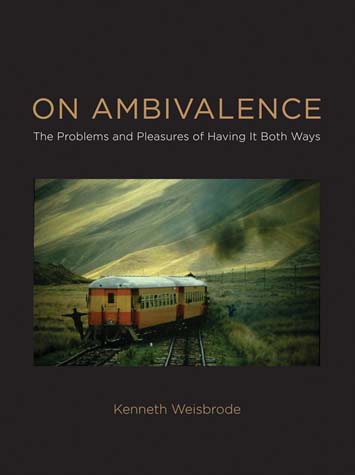
If you haven’t read Kenneth Weisbrode’s recent short book on the topic, entitled ‘On Ambivalence’ I can highly recommend it.

‘Ambivalence lies at the core of who we are. It is something more subtle, and more devastating than human frailty. Weaknesses can be remedied. Ambivalence comes, rather from too much ambition. Desire begets dissatisfaction, and vice versa. Optimization becomes a fetish. Wanting the ‘best’ means that we must have both or all and are reluctant to give up any option lest we pull up the roots of our desire. That is why ambivalence is so hard to confront, understand. Or master. And why it can be so disastrous.  Most of us know this. Yet we continue to deny it.’ (p2)


9780262017312

The person who is ambivalent about their eating, or drinking, or lifestyle ( add ad infinitum) is not only unable to choose the from the options they have in front of them, but refuses somehow to admit that there is even a choice to be made at all. It’s both a painful yet oddly pleasurable place to be. We cannot have it all, but still somehow  want to believe that we can. We don’t have to decide what to do, to change our lives, because there isn’t a decision to be made. Yet we suffer because we struggle to live what is an impossible existence, only we don’t admit how impossible it really is.

If I had understood this when I was younger, I might have been able to recognise how much suffering is rooted in ambivalence. I began to understand it when I worked in addictions, and later with people who had eating disorders.  I’ve talked to many people who have felt judged rather than helped by those they have consulted; who have been labelled as weak because they are unable to ‘choose to change their behaviour’, rather than essentially ambivalent about life and what they wanted from it. I was influenced by Bill Miller, who first described Motivational Interviewing in the 1980s. I remember reading about how the clients of the clinic where he worked were routinely asked if they were willing to accept the label of alcoholism and accept treatment. That was exactly what I witnessed as a junior doctor:

Consultant: ‘So do you think you are an alcoholic?’

Patient : ..’No… I don’t’

Consultant: ‘Are you prepared to attend AA?’

Patient: ‘Why would I want to do that.?’

Consultant: ‘Well, if you aren’t prepared to admit that, you aren’t motivated to accept help. Come back again when you are.’

We may say it doesn’t happen quite like now, but it does. A person who doesn’t see the need to make a decision about taking up therapy and attends only intermittently is rapidly discharged for being unmotivated.  Instead of trying to understand their ambivalence and empathising with the problems they are experiencing which make it impossible for them to contemplate a decisive response to their problems, we treat them as wasting our time. When he first described Motivational Interviewing, Miller emphasized the responsibility of the therapist in helping the client to acknowledge and explore their ambivalence. When the person is ‘unmotivated’ we are discharged, as therapists, from our responsibilities.

I was personally fortunate. I had a therapist who was prepared to engage me in acknowledging that I both wanted to succeed and to fail in my career, and ultimately to both to live and to die. I’m still ambivalent, but I don’t want to talk about that now. There isn’t time. My cat is currently driving me crazy, wanting to be on both sides of the back door at once. Now that’s ambivalence.


Relapse and rewind

It’s fortunate that my other half and I share the same acerbic sense of humour.

‘When you aren’t well you start to talk all the time, and about 80% of it is rubbish, ’ he told me, ‘and you’re doing that now.’

It was at this point that I was finally able to admit that my mood, up and down since last autumn, had taken a major nosedive since New Year. The problem is that when I’m going down, I don’t generally recognise it until quite late, and I’m not always willing to listen to advice to ‘slow down’. This time, along with the usual symptoms of depression I’m so familiar with, I experienced the worst constant physical symptoms of anxiety I have ever felt; resulting in panic when I lost my bearing in Manchester’s Arndale Centre and I couldn’t immediately find the way out. This time, nothing would relieve the anxiety apart from alcohol. What my other half was referring to was the emotional and verbal expression of my anxiety. The constant seeking of reassurance and ruminating out loud about life problems, in a way that probably drives those around me crazy too.

However given my history of recurrent depression, it’s no surprise really that I’ve had another relapse. I had hoped that since retirement I somehow wouldn’t experience the same stresses I used to. And I’d been pretty well for a couple of years at least. But I was wrong. Losing my animal companion and several major family and health stresses I won’t go into here were enough to tip the balance again. It was back.

It’s the beginning of March now. For a while I panicked when I simply switched on the desktop computer. Now I can write again. I burst into tears in the middle of my last blog but I forced myself to get it finished. I have this feeling that if I can’t write then somehow I couldn’t live. Maybe it isn’t right, but I kind of believe that. For the last couple of weeks I’ve gradually been feeling better and the constant anxiety is subsiding to its usual level. I don’t feel like something awful is going to happen imminently and I’ve stopped thinking about death (I was having passive thoughts that life wasn’t worth living again). I heard birdsong the other day as I walked up the garden path and I realised I hadn’t taken any notice of the birds in the garden or their choruses or the bulbs shooting up for…well I’m not sure; because depression creeps up insidiously.

Why is my mood lifting?

Perhaps it just would do anyway. Spring is on the way. I’m bound to feel better…except for me it doesn’t happen that way. Even after the events that precipitate it are all past, my downturn goes on and on, thought not as low or for as long as when I was off medication altogether.

I can only make sense of it as a combination of the following and as you might expect from me, it’s a biopsychsocial combination of remedies:

  • I found a way to talk about my worries and fears about the future with my partner. It wasn’t easy but we managed to resolve some practical things I was concerned about.
  • I was able to utilise some of the practical coping skills for managing my rumination I learned from cognitive therapy and I started to use the guided mindfulness CD I had always been ‘too busy’ to listen to. I tried to stop myself from fighting against my mood, and simply accept that I was feeling terrible: bleak sad and empty. Paradoxically once I do that, I’ve learned, it is always a little easier to move forwards.
  • I forced myself to keep going out even though I wanted to shut myself in the house and never come out again. I’ve met many people in my career who have done just that. I had to ‘feel the fear and do it anyway.’
  • I was able, too with support, to put aside some of the impossible self-imposed deadlines I place on myself. I have to remember that my ‘Rules for Living’ are nigh impossible to live up to. Instead I set myself somewhat simpler goals like going out for a walk, and doing some washing. Small achievements which then helped me to move forwards.
  • I agreed to a change of medication. I wasn’t happy about it. I’m now on multiple tablets for my various conditions, but at the point I was at, it was worth a try. I cannot bear the thought of being sedated by medication and fully understood all my patients who refused to take medication that numbed their thinking. My mind has to be clear but when I’m very low I can’t frame the words and sentences either. I try to get to somewhere in the middle. I just cannot do it without pharmaceutical aid.
  • I sought and accepted the support of friends, real life and on line.

My other half did his part by being there for me, as he always is, even if I am talking rubbish, and arriving home one evening with a present of Lindt chocolate bunnies. Chocolate has antidepressant properties too, I tell myself as I bite the head off one of them. He tells me he knows I am getting better because I’ve started to talk about it all in the past again now. I think I’m getting better too, but I wont really know until I can look back and recognise how much I’ve improved.

That’s the nature of the beast.

Listening to your body

“Listen to your body,” they always tell you…whoever they are. “If you are feeling tired and exhausted it means you are overdoing it.” I used to tell people that to. After all our body and mind are inextricably linked. What is going on inside my head will have an impact on how I am feeling, and vice versa.

But what if you don’t only ‘listen to your body’ but watch it too? Monitor it closely every day for changes. Observe how aches and pains seem to shift mysteriously from one joint to another. How your heart misses a beat, or speeds right up more often than it used to. How the pain that you woke with again today in your right arm (which you have self-diagnosed as tennis elbow) has increased in intensity as the small hand has moved around the kitchen clock…probably because you’ve been thinking about it all the time. And the more you dwell on it, the worse it becomes. “Is it arthritis?” you are beginning to ask yourself.

The fingers of both of my hands are stiff now every morning, and the base of my left thumb was painful again today opening the jam jar at breakfast. I know that my uncle developed rheumatoid arthritis when he was my age. He went from being a fit and healthy middle-aged man to a stooped elderly person wracked with pain in the course of only a year. Could this be happening to me? I told one of the GPs I see about my joint pains recently. I’m supposed to have a blood test- but I haven’t yet. I don’t know if I want to know the status of my anti-rheumatoid factor. I’ve started to worry much more about my health than I used to. The number of chronic conditions I have is slowly increasing…and with them my level of anxiety.

I’ve seen many people in my life with what used to be called ‘Medically Unexplained Symptoms, (MUS)’ (and have now been given the name Bodily Stress (or Distress) Syndrome although terminology differs between psychiatric classifications and will almost certainly change again). Symptoms for which there is no clear medical cause, although many suspect that if you look really hard you might find some physiological explanation for them. They were once called ‘functional’ symptoms and milder versions are really common in primary care and out-patient clinics. For example, around 50% of people who are seen in gastrointestinal clinics with new symptoms have a problem for which no obvious medical cause can be found. However, some people are severely disabled by multiple symptoms. They most commonly occur in the presence of other diagnosed and often chronic illness, and may be a sign of anxiety and depression, but this is not always the case. A person with otherwise unexplained symptoms often denies having any other problems that are worrying them, either psychological or social. Sometimes it becomes clearer later that they do indeed have a medical cause for their problems; we found this happened in about 10% of patients over an 18-month follow up period. Missing ‘real pathology’ is what a doctor fears (although they do seem less worried about missing mental health problems). I specialized in not only trying to help people with unexplained symptoms, but in doing research into how to train GPs to help them more effectively and be more understanding about their concerns. And I will admit here I have always experienced them myself to some degree too.

And now I find one particular person keeps coming back into my mind.

Jeff (not his real name) worried about pains all over his body, which he had for many years. He had multiple investigations, almost all of which showed nothing very much of note. We sat down together to go through his general hospital case notes together so we could discuss all the tests that had been carried out in several different departments. I always found this a helpful exercise in beginning to find a common ground with someone. Checking out what we could agree were the problems both in life and with health, and where we disagreed. Whatever the health worries, we could usually agree that the disability and pain interfered with their quality of life and relationships in a major way. Jeff was confined to bed much of the time, and found it very difficult to manage any kind of regular activity outside his home. He was angry and exasperated with the medical profession in their failure to either explain or help him. While we turned the pages Jeff asked questions, and I attempted to answer, explaining what particular phrases meant.

“So ‘at the top of the normal range’ it says there,” he pointed to a particular blood result, “that’s not good then is it, I mean its high isn’t it?”

“Well, it’s still within the limits of what is normal. That’s what’s important. It will also probably vary a bit each time its been checked.” We looked through previous pages and indeed the numbers went up and down. We were both relieved. We carried on much in the same way for about an hour then I noticed Jeff had fallen silent.

“So what do you think?” I asked.

He was looking down at his hands and flexing his fingers as though testing their range of movement. “Well I’ll be honest with you, doc.”

“Go on…”

“All these tests and scans…they’ve never checked my out here have they,” he said pointing to his left flank. “And that’s where the pain is worse at the moment. They’ve never scanned me right here have they?”

At that point I really didn’t know how to reply.

And now I know just how Jeff felt. Before my recent appointment at the kidney unit I was having persistent discomfort in my left flank too. I was constantly checking and prodding and trying to reassure myself, but it was only after the appointment, when I received the results of my latest scan, explained to my in details that I could understand, that I realized that the pains in my flank had actually disappeared completely. I had previously been told that the kidney on that side was enlarged, but this scan showed that wasn’t apparently the case. Only I now have pains elsewhere in my back, and in my joints too. Logically I know that the pains are worse when my mood is low, as I would have predicted; made worse by my level of anxiety. I focus on things I have reason to worry about due to my family history: such as heart disease and arthritis. I do have chronic kidney disease and now associated hypertension, hypothyroidism, irritable bowel syndrome, early signs of cataracts (yes my optician helpfully added that to the list this week) and a long-standing mood disorder. And now I have started to monitor my body just in the way (though not quite as obsessively) as one of my patients who used to chart the progression of unexplained spots across his body in his diary.

Reassurance doesn’t work. I’m worried about my health. The last thing I need to do is to watch or listen to my body. I really need to be distracted from it in a major way. I know that even if I am feeling tired if I don’t get out there and keep getting on with life, setting myself (achievable) goals, life will pass me by while I’m still checking my pulse!

I just have to keep reminding myself just as I used to remind my own patients of that…and keep going.

So that’s the plan then.

Surviving Christmas

Like many people I’ve never found Christmas easy to bear, yet I still find it strangely odd to admit to that. After all, it is so eagerly anticipated by many, especially the young. I make very little preparation and only do a little shopping at the last minute. I send few cards and hardly receive any now. I try and pretend Christmas day is ‘just like any other day’ except I have to cook a ‘traditional’ dinner, and every other year I cook for my mother in law too, which can be stressful. We watch a lot of television, and then, by halfway through Boxing Day, I simply cannot wait for it to be over. I want normal life just to begin again.

In the out-patient clinic, I would spend quite a bit of time before Christmas discussing with each person what their plans were for Christmas, especially those who were facing it on their own. What was he or she going to spend their time doing? Who could they contact if they needed to talk to anyone for support? What were our plans if there was a crisis? Then in the few days before New Year I would catch up with those people who needed urgent review or support and repeat the task for New Year’s Eve. Sometimes people would ask me if I was looking forward to the holiday and I would usually tell a little white lie, and say that I was, if only for the ‘rest from work and the chance to spend some time at home’.

I guess my problems with Christmas stem from unhappy memories of time spent in close quarters with a family who wanted to be able to enjoy themselves, but somehow, whether due to lack of money or simple intolerance of each other’s failings, never managed to get along. My father would take away the only lifeline we had on a day of enforced closeness by insisting on switching off the television and listening to ‘his’ music (twenties and thirties jazz- which I kind of appreciate now, but didn’t then) on the radiogram with the rest of us keeping him company in silence. I never really understood why he did this. It seemed to be a way of making a point about who was in control of the household, but in retrospect it seemed a peculiarly passive aggressive act. This would trigger an almighty argument between everyone, which generally continued until bedtime. By early afternoon on Boxing Day I was able to excuse myself from the misery without any further ire. By my teenaged years I was in the pub that evening and everything was, to my relief, almost back to normal. I just had to listen to how other people spent their Christmases. As a child you always imagine every else’s family is just like your own. Then you find out they are not. They are just strange in different ways.

The first time I realised I was going to spend Christmas on my own I felt quite ashamed to tell anyone. What does it say about me, I thought, that there was no-one who wanted to spend the ‘happiest’ time of the year with me? (I’m a miserable sod?) Yet I know now I was neither particularly abnormal nor very unusual. I was estranged from my family. The man my mother took up with after my father’s death was even more difficult to spend Christmas with. He would sit beside the fire in silence brooding over his broken marriage. There wasn’t even the relief of Fats Waller singing Aint Misbehavin’. I stopped going home altogether. Then I got divorced…and depressed again. And then I was completely alone.

What I learned was that there are ways to manage Christmas on your own, but you need to be prepared. I refused offers to go to friend’s houses as I didn’t want to be part of someone else’s celebrations, or to accept invitations out of what I, possibly wrongly, perceived as pity. I wanted to have my own special time for me…just for it not to be particularly Christmassy. Apart from a perverse enjoyment in belting out certain Christmas carols I don’t do ‘festive’ at all.

So the first year alone, I took myself to Paris for 4 days, and ate a Parisian Christmas meal alone in a Greek Restaurant on the Left Bank, which was open on Christmas Eve. Finding food on Christmas day was much harder, so it was fresh bread from the bakers, which at least open every day in France, in my little hotel room. One of those with faded wallpaper that goes all the way over the ceiling. I didn’t have any TV in English, but I had the streets of Paris to walk. It was ideal for occupying my mind.

The following year I decided I really must go somewhere where food would be easier to obtain over the holiday so I returned to France, driving all the way there in an old mini. I hadn’t had my licence very long, and it was scary. At one point I found myself trying to negotiate the roundabout at Hyde Park Corner as I didn’t want to go on the M25 to get to Newhaven where I took the ferry to Dieppe; but it was an adventure. I had a puncture and had to seek help at a garage. My schoolgirl French wasn’t really up to the task, and half a dozen men stood around looking at me quizzically. Yet when I said I was from Manchester someone said’ ah Manchester United!’ (apologies to City fans) and my little red car was whisked away and speedily repaired. I ate and drank well, and again walked for miles, this time around the small town of Honfleur, in Normandy. I found the grave of a relative who died just after D-Day and left flowers for him. I sat on the seawall at Deauville looking out to sea, watching Parisians trouping down the boardwalk with their dogs, and felt relieved of the burden of my expectations of Christmas.

I spent three Christmases alone, in succession. I was fortunate I could afford to travel away; it made it easier to bear for me, but many do not have this luxury. I don’t think I could have easily tolerated watching everyone else enjoying Christmas around me while I sat within my four walls. So I was really pleased to see there is recognition that many people, especially those who, like me, were and are estranged from their families of origin, will spend Christmas alone, in their own homes, and that there is advice available to help them cope with it.

I wish I’d had it then. I eventually perfected the art of eating alone in restaurants without drawing attention to myself, feeling conspicuous to the other guests or being openly pitied by either them or the waiting staff.

However that is probably another story.