
The morals of medication

Is taking medication for depression the ‘easy option?’ I come across this viewpoint regularly on social media. Usually there is a suggestion alongside that therapy, which I completely agree is hard work, is somehow a purer way to recover. The right way.

The history of psychiatry is rich in references to morality. Is a person ‘mad’ or ‘bad’? Is there really something wrong in the brains of those society labels as bad? Is addiction an illness or simply a behaviour choice? Are we excusing bad behaviour by medicalising it?

Many people who consider medication for depression will find themselves wondering whether it is a ‘good’ thing to take it. When you are depressed it can be very difficult to decide what is the best thing to do, and decisions are taken not only on the basis of discussion with health professionals- moral judgments also play an important part.

  • How does taking antidepressants affect how I feel about me? Does it mean that I am weak?
  • Is it the easy option?
  • Shouldn’t I be able to sort myself out without them?
  • What will other people think- my family- my friends…will it change how they see me?

Alice Malpass and her colleagues identified two parallel journeys that the depressed person embarks on. The ‘medical’ journey goes something like this:

  • I have a duty to be well. Other people need me to be well.
  • If I recover then there won’t be any risk of being seen as ‘mentally ill’.
  • I can get back to my old self and be in charge of my life again.

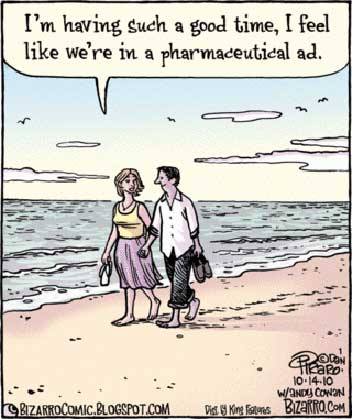
I’m sure I’ve used some of these arguments in conversation with patients. Any doctor who says they haven’t is not telling the truth- but to consider these are the only things of concern about medication is inherently simplistic and paternal, and reminds me of the cartoon of a couple walking along a beach, smiling and carefree, who say they feel so good they must be in a pharma advert.

In parallel the person is perhaps also on another journey- the ‘moral’ one.

  • I feel awful because I have to ask for help.
  • I feel even worse because I need to take tablets.
  • Is this person the real, authentic me? Am I now my old self or someone else? Or am I only this person because I am on tablets?
  • Am I hooked on these now?

Damien Ridge, who has analysed many interviews with people who are depressed talks not only about the lack of legitimacy for tablets, but also for what they are being prescribed for.

  • Is ‘depression’ real?
  • Shouldn’t I just ‘pull myself together’? Isn’t that what everyone else thinks?

There is a great deal of literature on whether ‘depression’ is ‘real’ or simply no more than unhappiness. And if it isn’t real, then the treatment for it cannot be legitimate either, little better than using street drugs- as one person in Ridge’s paper calls his tablets: ‘My dirty little habit’. I’ve spent my career arguing that to use the term depression is not simply medicalising misery but giving a name to a particular experience and quality of suffering which is not just unhappiness but a deep, dark, hopeless, despair. It has many causes, and it isn’t a single ‘phenomenon’ whatever DSM tells us. But it’s a state of mind that many people with different stories share in common. I experience it too. I have asked all of these questions of myself. I have watched colleagues who work in mental health look a little embarrassed when I get out the tablets at breakfast. Perhaps I do that simply to show I am not ashamed- but I do wish I could have lived my life without them.

All of the above supposes that antidepressants do actually work. Many people think they don’t, and others think they can do harm. You can find my views on these points elsewhere on this blog. I take them myself and they keep me reasonably well, but I have friends and colleagues for whom they have not worked- the medical journey is inherently optimistic- just like the pharma ads, but in reality life is far more complicated. And they are never sufficient on their own.

If doctors, and sometimes friends and family, try and influence you to focus on the ‘medical journey’ then others will try to steer your moral journey. It is really hard to focus on what is right for you when you cannot think clearly. When you are depressed, you are already struggling with guilt and shame and sometimes that can tragically end with the decision that the world is better off without you- that this is the right thing to do.

So I would only ask those who make even subtle comparisons between the easy way to ‘block out the pain’ with meds and the hard way of suffering through therapy to think before they write. It is only human to want to alleviate pain, and sometimes the tablets are the only thing that will do it. To infer that a person needs to suffer in order to be blessed is one of the ultimate moral judgments- and can be found in most religions.

Depressed or not, clinician or service user, expert or lay person-none of us have the right to sit in judgment over others.

My memoir: The Other Side of Silence: A Psychiatrist’s Memoir of Depression is available now.


Borderline Traits

A recent reviewer of my memoir about depression and psychiatry has noted that in describing the emotional mess of my early adult years and on-going struggles with low mood, I ‘courageously come close to defining traits of Borderline Personality Disorder’.

I really don’t mind her saying that- indeed part of me is actually surprised that she is the first person to do so. I purposefully included a description of my difficulty in relationships, mood swings and problems in trusting others alongside a description of similar problems in one of my own patients. I wanted to show not only the variety of ways that people can experience what we commonly call ‘depression’, but also how my own problems mirrored those of my patients, such that there was very little distance between us.

By this time, in my early thirties, I had already had quite a long period of psychodynamic therapy but was still having problems:

 I didn’t know how to begin to contain these frightening feelings when they took hold of me. There were times when I felt low in mood and physically exhausted, as though there was a weight bearing down on my chest, which prevented me from moving. On other occasions, it seemed as though anything and everything was possible. At those times I did seem to lose control and retreat from reality. It was then that the suicidal thoughts would return, although by then usually only fleetingly.

Nevertheless, I recognised only too well the persistent state of emotional chaos that Elizabeth Wurtzel described in her book, Prozac Nation. I particularly empathised with her when she talked about wanting a therapist who could help her to learn to be a grown-up and to show her how to live in a world where the phone company didn’t care that you were too depressed to pay the phone bill.   (From The Other Side Of Silence: A psychiatrist’s memoir of depression)

 I’m well aware that there are features of my personality and behaviour that could well be called ‘borderline traits’ and it’s interesting that no one else has mentioned this. Is it because I am a Professor of Psychiatry? Is this the kind of thing one shouldn’t  say to me?  Most people have been incredibly supportive about my honesty, but others- including one or two mental health professional colleagues, have seemed a little embarrassed by my openness. Some will have been on the receiving end of some of my irritability and anger in the past- which is always much worse when my mood is going down. If so, I can only offer my apologies, but might add that in my experience some mental health services can be less than sufficiently understanding of the emotional problems of those whom they employ.

As time goes by my views are changing, despite having written on the topic of Personality Disorder in the BMJ; and this largely because of my anger at the lack of access to appropriate therapy for people who need and deserve help, rather than abuse. I’ve always been aware that people like me who perhaps have ‘difficult’ personalities (I prefer to think there are also times when I can be very warm, creative and caring too) are often dealt a bad deal by mental health services, when they get depressed. Our difficulties with early attachments both make relationships difficult to cope with, and predispose us to longer periods of more severe depression and anxiety as well. I have considerable sympathy with the view put forward by Peter Tyrer that Borderline Personality Disorder is ‘neither borderline nor a personality disorder’. People given this label describe ‘symptoms’ for which they desperately seek help, and don’t demonstrate persistent and inflexible ‘traits’. Their problems are not necessarily lifelong (which I understand personality traits as being), and they can be helped to change over time.

My mood is still unstable at times, but not to degree it was before I had the right kind of therapy to help me comes to terms both my past with how to survive in the world. I also need medication to stop me from plunging down into prolonged despair- with all the associated physical symptoms of anxiety and depression.

People who have problems with their mood don’t fit into neat boxes. As I’ve argued before, diagnoses have their place in terms of research and predicting likely response to treatment, but they should be used alongside a plan that addresses their main presenting life problems, range of symptoms and underlying aetiological factors that may be maintaining the status quo. Some will call this a formulation, but it’s not simply a psychological one- it addresses all three of the key areas- biological, psychological and social.

We need to design the treatment around the person- looking at what they need, not excluding on the basis of a diagnosis that has become for many, a term of abuse. I know many will still want to use the term ‘borderline’ because it can help get access to the right kind of therapy; but we need to acknowledge that the difficulties some of us have with managing certain aspects of everyday life (without, for me, a little drama on occasions) are simply degrees of the extraordinary diversity of humanity- differences that we should learn to celebrate not abjure.

PS- my husband proofreads my blogs- and says life with me has always been a bit of a roller coaster at times- but he wouldn’t swap me for anything.


Lacking motivation

A common reason, in my experience, why people don’t get taken on for therapy  (or are discharged prematurely) when they are referred to a therapist is that they are deemed to be ‘lacking in motivation’. The concept of ‘being motivated’ is something I’ve thought quite a lot about because when I’m depressed I have very little motivation to get out of bed. So what is meant when people who are depressed are lacking in motivation to undertake therapy? Why should we think more about it?

To get taken on for a talking therapy, you have to jump through quite a few different hoops, several of which you may not realize are actually there:

  • First you have to recognize that you might actually need some help. That’s a pretty major step. Stigma in our community makes it difficult for many people to come forwards and identify themselves as having a mental health problem. In some minority communities, simply doing this can damage your sister or brother’s marriage prospects.
  • Then you need to be able to access the system, through your GP or by self-referral. That assumes that you can leave your house (many people with disabilities cannot) and negotiate the various other barriers to getting a referral including feeling able to talk to your GP, or using the telephone to refer yourself. All these can be doubly difficult if you don’t speak English. Information about services isn’t always available in other languages. Talking to people on the telephone can be difficult if you are very anxious.
  • •Next you have to understand what it is that you are being referred to. You many have no idea that you are expected to turn up at the same time every week for several weeks. You may be a single parent, who lacks reliable childcare. If out of hours appointments aren’t available you may have to tell your boss you need the time off and why. Not everyone has control over how they spend their day like most professionals do.
  • You may have a great deal of emotional turmoil in your life- relationships in crisis, money problems, ill-health in your family. You are not sure how you can commit to something you don’t really understand and how this can be a priority. No-one may yet have explained how therapy is supposed to help you.
  • A letter arrives. It takes you a while to open it because you haven’t been opening the post. It’s all bills anyway, and seeing them just gets you more upset. You’ve been finding it harder and harder to get going in the morning. The letter says you have to ‘opt in’ to therapy, by a certain date. You tear off the slip and send it back. Just in time.
  • When the assessment appointment finally comes after several weeks or months, you have to cancel because your child is seriously ill. The service tells you that you can only cancel twice then you will go to the bottom of the waiting list again. You try and leave another message but only get the answering machine. Repeatedly. You begin to lose hope. Things are getting worse and you seem to have even less energy than before. You have started to feel that life isn’t worth living anyway.
  • You finally get to see the therapist who asks quite a few questions, but you still aren’t entirely sure what you are supposed to do, or how this is supposed to help you. You tell her that you are taking tablets, which have helped a bit, but your doctor hasn’t reviewed them because he is waiting to hear what the therapist thinks. She tells you that this is nothing to do with her but a question for your doctor. She asks to see you again before making a decision. She says there will be six-month wait anyway to see somebody. You start to think ‘what’s the point?’ you are feeling increasingly hopeless.
  • The evening before you are due to see her, your husband comes home to say he has been made redundant and the two of you spend the evening wondering how you are ever going to cope. The therapist has sent a text to remind you of your appointment but it’s the furthest thing from your mind at the moment. You forget to go.
  • Two weeks later you get a letter offering you one more appointment. If you don’t attend you will be discharged and they will assume you no longer want to come. That last part of the sentence worries you, because you know you really need help now. You are losing weight, you have no energy any more and the future looks bleak. You put the letter in the bin.

The therapist writes to your doctor and says you don’t seem motivated to attend at the moment, and sends you a copy.

There are many things that can contribute to a perceived ‘lack of motivation’. Not being willing to attend regularly (because of what that means in terms of who you have to tell and negotiate with); not able to understand what therapy is about and your role in it (because no-one has still really explained it); not prioritizing therapy because your life is in turmoil (a difficult ask for people who live life on the edge of an economic abyss) or simply feeling so hopeless and lacking in energy that you don’t manage to get there ( symptoms of severe depression).

The responsibility has been put back onto you. The therapist didn’t seem to want to talk about the problems you were facing in your life and your money difficulties. Only what you thought and felt about them. They didn’t address how ambivalent you feel about the whole enterprise or try to really engage you in a way you could respond to. They didn’t seem to understand how difficult you found it to make any decisions at all, never mind commit to ‘therapy’ and when you talked about how you had begun to think of harming yourself they did seem concerned but didn’t seem to know what to say.

You may think this tale is an exaggeration, but it is simply a reflection of what service users have told me many times about their experiences.

Once upon a time you had to be ‘Young, Attractive, Verbal, Intelligent and Successful’ to get into therapy. Now, above all, you have to be motivated. Have things changed?

My new book: ‘The Other Side of Silence: A Psychiatrist’s Memoir of Depression,’ is available now, and describes my own experiences of therapy.

The problem with resilience

‘Resilience’ is one of those words its hard to avoid at the moment. No one seems to be quite sure what it means, but one suggestion has been that it refers to a person’s ability to maintain or regain a state of mental health in the face of significant adversity or death; in which case it is a quality in which I am undoubtedly lacking. I am very sensitive to the ups and downs of life especially loss. I get anxious and depressed; I’ve had periods off work. I may have successfully survived a lifetime of work as a psychiatrist and an academic, but I’ve also had to use mental health services to keep afloat. Life in the NHS is challenging and I’ve not got through my career without some serious wounds to show for it.

Before the word ‘resilience’ achieved common usage, and its current prominent space on the buzz word bingo board of healthcare, I understood it broadly to be inversely related to the degree of vulnerability conferred by a combination of genetic heritage (see Goldberg & Goodyer)- which influences our temperament, personality and susceptibility to some types of mental health problems, early life experiences and social learning in childhood. If a group of people are exposed to the same degree and type of stresses most will cope, they will demonstrate resilience, but a minority will not. We all have differing degrees of it. Some will develop common mental health problems like depression and anxiety in response to traumatic events, and others less common ones, such as psychosis, but many others will get through relatively unscathed.

The General Medical Council (GMC) with whom I am still registered, although I no longer practice psychiatry, has recently decided that the current generation of doctors is less resilient than those in the past and students need to undergo resilience training in order to be tough enough for the job. I have a number of problems with this view:

  • As an excellent review of the topic by Balme and her colleagues in BMJ Careers recently stated ‘there are no consistent definitions, no standardized, valid or reliable measurements; and no robust studies into what resilience is, what the predictors of resilience are, and whether resilience is related to better patient care.’
  • So if you intend to screen for it please check out this first. If I were starting medical school now (and I still dream I haven’t yet passed my finals) I would want to know, as will others, exactly what it is I am lacking in (given that I tend to get depressed I will likely feel guilty and even more insecure) and whether being without it is going to be of harm to anyone but myself. We don’t screen out people with diabetes from being health professionals. Why should we even consider doing that with people who might be vulnerable to depression.
  • Because in an increasingly hostile working environment the reality is health care professionals are going to experience more mental health problems. They are human beings like the rest of us, although they are not encouraged to admit they need help, for fear of appearing weak. The culture is tough enough already.
  • Please don’t dress up this quality called ‘resilience’ as something for which they must take full responsibility (I have a problem because I lack resilience) rather than the NHS (I’m not very well because I do not work in a supportive and caring workplace). As Balme et al. point out resilience is always contextual – it’s a complex interplay between the person and their environment.
  • Please don’t assume that attending a few short workshops would increase my resilience much either. The evidence for the effectiveness of resilience training is patchy at best, and though there is a suggestion of some positive outcomes, these are mainly from self-report in studies lacking rigorous methodology. It might be more effective to address these problems I have in relating to the world and coping with stress much earlier in life before any thought of being a health professional is even a twinkle on the horizon.
  • What I would need is help to identify coping strategies like problem-solving. There is evidence that this works for people with depression, and those who self-harm in response to life stresses. I wish someone had taught this to me in childhood, it might have helped me earlier. I would need things I can rehearse to put into action at times when life gets tough. But I’m also going to need to be encouraged not feel too ashamed to ask for support and how to identify I might need it earlier rather than later, as so many health professionals who have consulted me have been unable to do. Fast and confidential access to help and support too, not having no choice but to consult a service that I work in, which happens to so many people now in mental health services in the UK.
  • And finally, please don’t assume that just because I’m not as tough as the GMC would perhaps like me to be, I would not be a good doctor. Since my book was published a month ago, I’ve heard from medical students who have feared for their future because they have experienced mental health problems at medical school, worried that they will not be strong enough to cope. Yet these very young people, who have experienced what its like to be a patient can bring a very special dimension to their work. Like me, they know what its like to be on the other side.

We all differ in our ability to deal with traumatic events and the stress of work, yet within that spectrum of abilities lies the potential for us to learn to listen, support and care for each other: as friends, colleagues, some managers and a insightful and proactive occupational health service did for me; supporting me through my sometimes difficult career.

My memoir about experiencing depression during my career in psychiatry is out now: The Other Side of Silence: A Psychiatrist’s Memoir of Depression ‘published by Summersdale.

Two units under

According to my other half, I am one of those people who are permanently short of two units of alcohol. I’m undoubtedly better company when slightly I’m under the influence- I’m more sociable and relaxed. I can engage in conversation without feeling self-conscious when I’m with people I don’t know well, or haven’t seen for a while. Life just flows more easily. Two units a day, you say, that isn’t very much, its 14 a week, that’s just on the ‘safe limit’ for women. So why have I been trying to reduce the amount that I drink?

Since my early 20s I’ve been aware that I have an ambivalent relationship with alcohol. Most of the time we remain on reasonably good terms, but when my mood is low, or I’m under stress the booze likes to get one up on me. Like many people, when I was working full-time, I began to rely a little too much on my liquid friend. Days began to be measured on a new scale of severity- the number of bottles of Stella Artois I needed to feel relaxed after a weekday in the real world. One bottle (330ml 2 units) was a normal dosage, two bottles (4 units) for a tough day and 3 bottles (6 units- thankfully not very often) for a bloody awful day, plus a very strong Martini on Friday night to decompress and sometimes again on a Saturday, and wine (3-4 glasses) over the weekend. Mostly I drank just about up to the limit. Sometimes, and increasingly so as time went by, I exceeded it.

Okay, I can hear you saying, ‘what are you worried about, I know loads of people who drink a lot more than that!’ You may even do so yourself. I’m not asking you to consider it that is of course your choice. But it’s not only the amount you consume (although most diseases related to alcohol haven’t been informed there are ‘safe’ limits, the risk just gets greater the more you drink) it’s the nature of the relationship you have with booze. It’s addressing why you sometimes feel the need to rely on a friend whose apparent affability, social and legal acceptability masks the risk it poses for those of us who have the potential to depend on it, not just emotionally but physically too if we drink long and hard enough. Earlier this year, when I was experiencing, for a while, the most severe physical symptoms of anxiety I have ever known, when my chest was permanently tight and my hands shaking, there was only one substance easily accessible that took those symptoms away, and it usually took one of my husband’s martinis which is a fairly lethal combination of gin and vodka (plus Lillet Blanc and a twist of lemon if you are interested) to help me feel anything like calm. Mindfulness exercises didn’t touch it. Exercise was difficult as I felt exhausted most of the time and too anxious to venture out much. I’m quite sure diazepam would have worked too, but I’ve spent so many years trying to help people withdraw from it I wouldn’t wish to take it. I remember one of my patients who was depressed and couldn’t sleep said to me. ‘I didn’t want to take any pills, so I just decided to try alcohol, it’s a natural remedy isn’t it? Well no, it’s about as natural as anything that’s been processed by a brewery or distillery can be I suppose. And the Distiller’s Company also gave us thalidomide too. Not that I am any way comparing alcohol with that particular drug, but we know it also can cause terrible damage to the unborn. Alcohol is acceptable, available and costs comparatively less than it used to when you buy it in bulk at the supermarket or in Happy Hour.

When I worked as a consultant in a substance misuse service I saw so many young men whose problems with alcohol had begun in their teens, when they drank to self-medicate for social anxiety, unable to approach a member of the opposite sex when completely sober. The problem is alcohol doesn’t only relax you, it lowers your inhibitions in other ways. You are more likely to put yourself at risk, for example by having unsafe sex or walking home in the snow with insufficient clothing after a night out risking hypothermia, when you are drunk. Alcohol has a curious relationship with mood disorders that mental health services in the UK (but not in Australia) still don’t pay enough attention to. People with bipolar disorder can drink excessively when they are high and when they are low. Those of us with depression use alcohol to numb the pain of being alive, but the side effect is that we then feel much less inhibited about trying to harm ourselves or end our lives. When I was a student I discovered the advantages and disadvantages of drinking to oblivion. I was in danger of becoming the person we all remember who seemed to go that little bit further than everyone else, and we much later heard was not only emotionally but physically dependent on booze and on their way to destroying their career. Medicine is noted for its relationship with alcohol. There even used to be a bar in the doctors residence in Manchester when I was a junior doctor. I’ve glibly asked students at interview what they do to relax, because ‘medicine is an emotionally taxing profession’, and heard them list all their sporting and musical activities knowing full well how many of us fall back on the nightly Stella because it’s the easy, instant option.

So, of late, I’ve been considering this relationship much more honestly than I have in the past. I’m aware I have within me the potential to spend far too much time with this erstwhile friend and be lead seriously astray, but I’m still ambivalent. l so love the feeling of being intoxicated, at least until I wake in the early hours next morning. But I rarely allow things to go that far now. I’ve been staying alcohol free for longer and longer, particularly when I’m in Scotland. I don’t drink alone in the house, and I can no longer have anything at all when I’m out due to the new drink driving laws. I hope they are having an effect on the overall amount people consume, but we still need legislation on minimum pricing. I learned as a medical student that national consumption was governed by cost and availability. Why is more research required?

I still enjoy the occasional drink but I’m beginning to know, and like, my persona who is always two units under a little better and helping her find other ways to manage her anxiety. It’s a healthier option for me, in the longer term, giving alcohol the brush off.

Relapse and rewind

It’s fortunate that my other half and I share the same acerbic sense of humour.

‘When you aren’t well you start to talk all the time, and about 80% of it is rubbish, ’ he told me, ‘and you’re doing that now.’

It was at this point that I was finally able to admit that my mood, up and down since last autumn, had taken a major nosedive since New Year. The problem is that when I’m going down, I don’t generally recognise it until quite late, and I’m not always willing to listen to advice to ‘slow down’. This time, along with the usual symptoms of depression I’m so familiar with, I experienced the worst constant physical symptoms of anxiety I have ever felt; resulting in panic when I lost my bearing in Manchester’s Arndale Centre and I couldn’t immediately find the way out. This time, nothing would relieve the anxiety apart from alcohol. What my other half was referring to was the emotional and verbal expression of my anxiety. The constant seeking of reassurance and ruminating out loud about life problems, in a way that probably drives those around me crazy too.

However given my history of recurrent depression, it’s no surprise really that I’ve had another relapse. I had hoped that since retirement I somehow wouldn’t experience the same stresses I used to. And I’d been pretty well for a couple of years at least. But I was wrong. Losing my animal companion and several major family and health stresses I won’t go into here were enough to tip the balance again. It was back.

It’s the beginning of March now. For a while I panicked when I simply switched on the desktop computer. Now I can write again. I burst into tears in the middle of my last blog but I forced myself to get it finished. I have this feeling that if I can’t write then somehow I couldn’t live. Maybe it isn’t right, but I kind of believe that. For the last couple of weeks I’ve gradually been feeling better and the constant anxiety is subsiding to its usual level. I don’t feel like something awful is going to happen imminently and I’ve stopped thinking about death (I was having passive thoughts that life wasn’t worth living again). I heard birdsong the other day as I walked up the garden path and I realised I hadn’t taken any notice of the birds in the garden or their choruses or the bulbs shooting up for…well I’m not sure; because depression creeps up insidiously.

Why is my mood lifting?

Perhaps it just would do anyway. Spring is on the way. I’m bound to feel better…except for me it doesn’t happen that way. Even after the events that precipitate it are all past, my downturn goes on and on, thought not as low or for as long as when I was off medication altogether.

I can only make sense of it as a combination of the following and as you might expect from me, it’s a biopsychsocial combination of remedies:

  • I found a way to talk about my worries and fears about the future with my partner. It wasn’t easy but we managed to resolve some practical things I was concerned about.
  • I was able to utilise some of the practical coping skills for managing my rumination I learned from cognitive therapy and I started to use the guided mindfulness CD I had always been ‘too busy’ to listen to. I tried to stop myself from fighting against my mood, and simply accept that I was feeling terrible: bleak sad and empty. Paradoxically once I do that, I’ve learned, it is always a little easier to move forwards.
  • I forced myself to keep going out even though I wanted to shut myself in the house and never come out again. I’ve met many people in my career who have done just that. I had to ‘feel the fear and do it anyway.’
  • I was able, too with support, to put aside some of the impossible self-imposed deadlines I place on myself. I have to remember that my ‘Rules for Living’ are nigh impossible to live up to. Instead I set myself somewhat simpler goals like going out for a walk, and doing some washing. Small achievements which then helped me to move forwards.
  • I agreed to a change of medication. I wasn’t happy about it. I’m now on multiple tablets for my various conditions, but at the point I was at, it was worth a try. I cannot bear the thought of being sedated by medication and fully understood all my patients who refused to take medication that numbed their thinking. My mind has to be clear but when I’m very low I can’t frame the words and sentences either. I try to get to somewhere in the middle. I just cannot do it without pharmaceutical aid.
  • I sought and accepted the support of friends, real life and on line.

My other half did his part by being there for me, as he always is, even if I am talking rubbish, and arriving home one evening with a present of Lindt chocolate bunnies. Chocolate has antidepressant properties too, I tell myself as I bite the head off one of them. He tells me he knows I am getting better because I’ve started to talk about it all in the past again now. I think I’m getting better too, but I wont really know until I can look back and recognise how much I’ve improved.

That’s the nature of the beast.

Listening to your body

“Listen to your body,” they always tell you…whoever they are. “If you are feeling tired and exhausted it means you are overdoing it.” I used to tell people that to. After all our body and mind are inextricably linked. What is going on inside my head will have an impact on how I am feeling, and vice versa.

But what if you don’t only ‘listen to your body’ but watch it too? Monitor it closely every day for changes. Observe how aches and pains seem to shift mysteriously from one joint to another. How your heart misses a beat, or speeds right up more often than it used to. How the pain that you woke with again today in your right arm (which you have self-diagnosed as tennis elbow) has increased in intensity as the small hand has moved around the kitchen clock…probably because you’ve been thinking about it all the time. And the more you dwell on it, the worse it becomes. “Is it arthritis?” you are beginning to ask yourself.

The fingers of both of my hands are stiff now every morning, and the base of my left thumb was painful again today opening the jam jar at breakfast. I know that my uncle developed rheumatoid arthritis when he was my age. He went from being a fit and healthy middle-aged man to a stooped elderly person wracked with pain in the course of only a year. Could this be happening to me? I told one of the GPs I see about my joint pains recently. I’m supposed to have a blood test- but I haven’t yet. I don’t know if I want to know the status of my anti-rheumatoid factor. I’ve started to worry much more about my health than I used to. The number of chronic conditions I have is slowly increasing…and with them my level of anxiety.

I’ve seen many people in my life with what used to be called ‘Medically Unexplained Symptoms, (MUS)’ (and have now been given the name Bodily Stress (or Distress) Syndrome although terminology differs between psychiatric classifications and will almost certainly change again). Symptoms for which there is no clear medical cause, although many suspect that if you look really hard you might find some physiological explanation for them. They were once called ‘functional’ symptoms and milder versions are really common in primary care and out-patient clinics. For example, around 50% of people who are seen in gastrointestinal clinics with new symptoms have a problem for which no obvious medical cause can be found. However, some people are severely disabled by multiple symptoms. They most commonly occur in the presence of other diagnosed and often chronic illness, and may be a sign of anxiety and depression, but this is not always the case. A person with otherwise unexplained symptoms often denies having any other problems that are worrying them, either psychological or social. Sometimes it becomes clearer later that they do indeed have a medical cause for their problems; we found this happened in about 10% of patients over an 18-month follow up period. Missing ‘real pathology’ is what a doctor fears (although they do seem less worried about missing mental health problems). I specialized in not only trying to help people with unexplained symptoms, but in doing research into how to train GPs to help them more effectively and be more understanding about their concerns. And I will admit here I have always experienced them myself to some degree too.

And now I find one particular person keeps coming back into my mind.

Jeff (not his real name) worried about pains all over his body, which he had for many years. He had multiple investigations, almost all of which showed nothing very much of note. We sat down together to go through his general hospital case notes together so we could discuss all the tests that had been carried out in several different departments. I always found this a helpful exercise in beginning to find a common ground with someone. Checking out what we could agree were the problems both in life and with health, and where we disagreed. Whatever the health worries, we could usually agree that the disability and pain interfered with their quality of life and relationships in a major way. Jeff was confined to bed much of the time, and found it very difficult to manage any kind of regular activity outside his home. He was angry and exasperated with the medical profession in their failure to either explain or help him. While we turned the pages Jeff asked questions, and I attempted to answer, explaining what particular phrases meant.

“So ‘at the top of the normal range’ it says there,” he pointed to a particular blood result, “that’s not good then is it, I mean its high isn’t it?”

“Well, it’s still within the limits of what is normal. That’s what’s important. It will also probably vary a bit each time its been checked.” We looked through previous pages and indeed the numbers went up and down. We were both relieved. We carried on much in the same way for about an hour then I noticed Jeff had fallen silent.

“So what do you think?” I asked.

He was looking down at his hands and flexing his fingers as though testing their range of movement. “Well I’ll be honest with you, doc.”

“Go on…”

“All these tests and scans…they’ve never checked my out here have they,” he said pointing to his left flank. “And that’s where the pain is worse at the moment. They’ve never scanned me right here have they?”

At that point I really didn’t know how to reply.

And now I know just how Jeff felt. Before my recent appointment at the kidney unit I was having persistent discomfort in my left flank too. I was constantly checking and prodding and trying to reassure myself, but it was only after the appointment, when I received the results of my latest scan, explained to my in details that I could understand, that I realized that the pains in my flank had actually disappeared completely. I had previously been told that the kidney on that side was enlarged, but this scan showed that wasn’t apparently the case. Only I now have pains elsewhere in my back, and in my joints too. Logically I know that the pains are worse when my mood is low, as I would have predicted; made worse by my level of anxiety. I focus on things I have reason to worry about due to my family history: such as heart disease and arthritis. I do have chronic kidney disease and now associated hypertension, hypothyroidism, irritable bowel syndrome, early signs of cataracts (yes my optician helpfully added that to the list this week) and a long-standing mood disorder. And now I have started to monitor my body just in the way (though not quite as obsessively) as one of my patients who used to chart the progression of unexplained spots across his body in his diary.

Reassurance doesn’t work. I’m worried about my health. The last thing I need to do is to watch or listen to my body. I really need to be distracted from it in a major way. I know that even if I am feeling tired if I don’t get out there and keep getting on with life, setting myself (achievable) goals, life will pass me by while I’m still checking my pulse!

I just have to keep reminding myself just as I used to remind my own patients of that…and keep going.

So that’s the plan then.

Fear of flying

Last week I had one of the most frightening journeys I’ve ever experienced in my life. I flew back into Orkney in the middle of the ‘weather bomb’ that hit Northern Scotland. Despite the forecast, it was surprising calm as the Loganair flight left Aberdeen, but after we had been served the customary tea and Tunnock’s caramel wafer I always look forward to, the wind began to buffet the plane violently, not only from side to side but also up and down. As we came out of the clouds towards the islands we turned on dipped wing into a curve that I soon recognised as the familiar holding pattern.

“Sorry about this,” came the calm voice of the female co-pilot, “there’s a snowstorm at the airport in Kirkwall so it’s going to be a little while before we can land.”

For the next fifteen minutes or so, it may have been longer I lost track of time, we jerked through troughs and peaks of stormy shades of grey, occasionally illuminated by a flash of lightning. My hands, cold and clammy by now, gripped the armrests. My stomach rose up into my throat as I shared false smiles with a woman seated across the aisle. Behind me, another passenger lost the contents of her stomach. As I caught occasional glimpses of the flinty sea just below I began to have those familiar thoughts: ‘is this where it will end, after all?’

A few days before I had been working with fear of a different kind as novice therapists I was teaching about suicide talked about the anxiety which comes with not knowing how to cope when you, as a mental health worker, are faced with someone who might want to end their life.

From my early days in psychiatry I had to try and learn how to cope with uncertainty. I often meet doctors, nurses and other health professionals who quiz me about what is the ‘right’ thing to say or do in a particular situation; as though we can always be prepared for whatever we have to face in a consultation, and handle it ‘properly’. As if, by some magic, we can always find out exactly what the chances are of a person seriously harming themselves by asking them the ‘right’ questions, and manage any situation by being ‘ready’ with the ‘correct’ words and interventions. So that they will be safe…and we will of course not be criticised.

The problem is that it simply isn’t possible for any of us, therapists, doctors, patients or service users, to be sufficiently primed to deal with everything in work (or life) beforehand. There are too many different permutations possible. You have to learn how to use the knowledge, skills and particular talents you have and the information you can glean at that particular moment, to do the best you can to help someone in the time available. In talking to a patient, a mental health worker has to work hard to gain a person’s trust so that the answers to his or her questions will be at the very least some reliable refection of how they are feeling. In order to achieve this the worker has to be able to contain their own anxieties; about their own performance, the safety of the patient, what might or might not happen, in order to help the patient contain theirs. If the worker is struggling to deal with their own fears, such as being simply overwhelmed by the enormity of the person’s problems, the person seeking help will not feel safe enough at that moment to share how they feel- and the worker probably will not obtain an emotionally accurate sense of what is happening for them.

Its not only novice mental health workers who find it hard to manage uncertainty. I meet some quite experienced professionals who are still very obviously struggling to cope with their own fears. For me, it indicates they need a time and place to share their worries about the job. Supervision is still sorely lacking for many workers. As a consultant psychiatrist I regularly shared my concerns with my closest colleagues but I had no formal arrangement for support and supervision. But I have seen how, if we don’t learn to cope successfully with the uncertainty and fear we face in our work, we manage it in other ways. By detaching ourselves from the pain and becoming less empathic; by trying to dissolve it in alcohol and other substances; or just trying to exert an even greater control over the world, searching for answers to those unanswerable questions I get asked at the end of lectures which always raise an uncomfortable laugh from the audience. Our fear is palpable to our colleagues as well as patients.

If we can acknowledge the limits of certainty we have a least a good chance of reaching out and helping a person to tolerate the fear they are experiencing when they begin to tell us about something awful- like their thoughts about dying or the abuse they faced in childhood. Then we can begin to give them some hope. The first step in this must be staying calm, and showing we can take it.

I used to be very afraid of flying. I suppose I’ve undergone a prolonged course of desensitization over the years, but my palms still sweat at every take off and landing. Last week they were wringing wet.

After one run at the airfield which was aborted because of a ‘build up of traffic waiting to get in’ we eventually landed at Kirkwall. I was emotionally drained and almost tearful. But I know that what helped me to contain my fear of dying in the storm was the reassuring commentary of the co-pilot. Her calm professionalism helped. There could have been panic in the cockpit. But it didn’t show.

“Ladies and gentlemen, I know it’s been a difficult flight but you’ll be pleased to know they have just checked the runway; it’s safe and we’ll have you on the ground in a few minutes now.”

I wanted to thank and hug her, but I didn’t…being British of course. So I just said ‘goodbye’ with a teary smile, and stepped onwards into the rain. Happy to still be alive.

Work

I’m going to write about a topic I know nothing about, at least not from the viewpoint of an expert in the published research, but as that doesn’t generally stop many other people I don’t see why it should inhibit me. I have after all worked for most of my life so I’ve plenty of lived experience; and I’ve treated many people who have been struggling to get back into work, or suffering ill-health as a consequence of the toxic environment in which they work. Its eighteen months now since I retired from the University, and a year since I gave up my clinical work and drastically reduced my workload. I’ve been told that work is something that is good for our mental health, so I can only tell you that I feel better physically and mentally overall than I have for several years. People tell me I look younger. I regularly apologise for having thrown in the towel; but it has been something of a fight- to get to the point where I could be done with the job before it did for me.

Please don’t get me wrong, I always enjoyed the interactions with patients and service users, and if I miss anything, it’s the feeling of making a difference in a person’s life; connecting with them and helping them to achieve some change. However I do know that if I had stayed in the NHS rather than being able to move into an academic post quite early in my career I would have been forced into taking even earlier retirement many years ago. I didn’t find the health service to be a sympathetic employer, either in the face of my own episodic periods of depression, which sometimes required time off work, or that of my patients who worked in the system- doctors, nurses and allied professionals. Not only was the macho style of management one of the factors that made it difficult for people to return to work with some degree of flexibility, it was sometimes a key factor in a person becoming depressed or severely anxious in the first place. I personally experienced bullying on more than one occasion, which contributed to several months off work. I know I’m less resilient than I sometimes appear to be.

My patients in the private sector had very mixed experiences. I remember one man who was criticised at work for needing to take breaks to ensure he ate at regular times- he had type 1 diabetes. When he got depressed they sacked him. Another patient with longer-term mental health problems was a poster-girl for a supported back to work scheme. The supermarket who took her on were very keen to be involved, but after a few months, after the support had been withdrawn and a ‘success story’ publicised, expected her to ‘work like everyone else’. Her voices returned as she became increasingly stressed and paranoid. She lost the job. In contrast, a person who worked for a large multinational company was allowed to return to work gradually over an extended period of time, and the occupational health department regularly consulted with all of us to ensure we were all agreed with the plan. They viewed my patient as a valued employee with expertise and experience they did not want to lose. I wish I could say that the NHS generally responded in a similar way. But it didn’t.

So where does this take me? Well, now the end goal of Recovery seems to be to get into paid work. Indeed attendance at Recovery Colleges has been sanctioned in order to apparently assist people with mental health problems to do so. Aside from the fact that, if Recovery were so straightforward all we needed to do was attend a course in it (and I don’t believe it is for many people), I’m very concerned about what we are sending many people back into. Not everyone is an academic who can work flexibly and take time off without risking their employment, I know that. However many more people do jobs from which they gain little sense of self-worth or value beyond simply earning a living. I’m a working-class girl. My parents both clocked in at 7.30 every morning and neither of them would have described their jobs as particularly fulfilling. What they did get was company, an opportunity to use some of their skills at least and a pay-packet. As a student I worked on supermarket checkouts, served in a bar and waited on tables for employers who varied considerably in their attitudes to ill-health. I wouldn’t have coped with those jobs at all if I had been depressed- nor would I have been in any great hurry to return. I personally know people who would never be able to cope with the stresses of regular employment again, yet they are repeatedly reassessed with the constant threat of losing their benefits. This just acts as a further stressor- we all know its cruel and has led to suicide.

So I have doubts about paid employment being the right goal for everyone. Surely it isn’t just about ‘work’ but how we spend our day? Yes, I know we have to bring in an income, but I’ve personally met very few people who really didn’t want to work. What they wanted was a supportive plan to help them move towards employment. A plan which might also involve volunteering and further study or training to gradually help them rediscover a sense of who they were, where they were going, and what goals they could realistically achieve. Not a simple ‘course’ but a journey, which might end in a regular job, but might not if that wasn’t right or possible. A much more humane solution than we are presented with now.

So don’t tell me that work is always good for me, because I know it isn’t. If it was, I wouldn’t be sitting here, feeling quite relaxed, writing this blog. I’d be on call. Or writing another grant proposal.

Whew!

‘Misery’, moods and madness

I find I learn what I think about something as I write about it. Composing words on a screen (I stopped writing by hand when I gave up clinical work- I have a writing corn from years of scribbling in notes) helps me to formulate what exactly it is that is troubling me. But for a few weeks I’ve had difficulty writing anything very creative other than a single blog. I’m well aware I’ve been grieving for my beloved cat; I was feeling very sad but I began to feel a little better again. Then I had a visit from a family member, which stirred up unwanted thoughts (and dreams) about the past.  I began to ruminate again about all sorts of other ‘stresses’ in my life although I’m still not sure how really threatening they actually are, and, for a couple of weeks, my mood plummeted downwards.


It’s become fashionable in some circles not to use the word ‘depression’ but to refer to ‘misery’ instead. ‘Depression’ is a contested concept and there is a powerful view that it is primarily a state that is socially determined, a natural response to life events that will respond to social and/or psychological intervention without the need for anything more. Particularly medication.


While I wholeheartedly agree that the DSM concept of a unitary ‘depression’ is simplistic and that there are, as the founder of the Black Dog Institute in Australia, Gordon Parker, has suggested, many different ‘depressions’, I really must draw the line at the increasing use of the word ‘misery’. To be described as ‘miserable’ not only means being constantly unhappy but also has connotations of wretchedness and being an awful burden to others. ‘Misery’ as an idea I can just about tolerate, but to be described as miserable because you feel down feels like yet another form of stigmatization of the ‘undeserving poor’ who are unable, or cannot be bothered, to help themselves.


And the question is should all experiences of depression now be lumped together as a result of social causes? This is as simplistic to me as suggesting its all down to incorrect or ‘faulty’ thinking or something wrong with the level of monoamines in the synapse. All of these are, for me, similarly discredited ideas. Surely our brains (and our experiences) are worthy of more complex theories than these?


What I’ve learned is that there are times when something really seems to shift in my mood, as though some unseen worker in my brain pulls a lever.  Usually this happens in response to a build up of life events (yes, social factors play a key part), and when these events are of a particular kind that holds an inherent threat to my sense of who I am (the psychological part), then my mood is much more likely to shift, and quite rapidly too. When I was working full time I could move from feeling anxious, but keeping my head above water, to quite a different state of mind, within a day. When I am there I feel quite different. I don’t only feel sad, I feel physically ‘changed’; heavy of limb, tired, unable to sleep yet also very agitated. I ruminate about things that at other times I would be able to cope with easily and I am full of ‘fear’. When I look in the mirror I am quite sure I can see it in my eyes. There are times when my fear can shift into frankly paranoid thoughts and feelings of wanting to end my life. It’s terrifying and yet oddly familiar at the same time. I’ve been there many times, and I’ve just been there, albeit fairly briefly this time, again.


I’m fortunate that I haven’t had depression severe enough to warrant admission to hospital but I’ve had several episodes in my life. Why does this happen to me, but not to so many others who seem to be much more resilient? If I’m just ‘miserable’ perhaps it’s because I’m just inherently weak? For me, this is the obvious conclusion I must draw.


What I do believe is that ‘depression’ is a complex, multidimensional experience incorporating everything from profound and painful unhappiness to suicidal thoughts and psychotic degrees of despair. As I’ve said before, ‘depression’ and ‘anxiety’ are also very closely linked to the degree that I don’t find the idea of diagnostic co-morbidity useful at all.


The only way I can explain why only some of us seem to become depressed in response to life events is by drawing on the concept of vulnerability. A combination of genetic factors, early life experiences and unremitting life stresses such as lack of support and long-term physical illness add to our vulnerability. Such that, when a torrent of life events come along, those of us who have the greatest vulnerability and lowest threshold for becoming depressed, will get washed away by the waves while those who are fortunately more resilient seem to remain standing.


I don’t find it difficult to identify all of those factors in my own life. I’ve used biological (medication), psychological (therapy) and social (retirement from a stressful job) strategies to overcome them. Most of the time now, it works for me.  But there are still likely to be times when my mood just seems to switch gear again and I begin to see an image of the world distorted through a glass, darkly. I’ve never been clinically high, but when I begin to feel better I do sometimes feel an odd surge of well-being to be back in tune with life again.

Just please don’t call me ‘miserable’.