Relapse and rewind

It’s fortunate that my other half and I share the same acerbic sense of humour.

‘When you aren’t well you start to talk all the time, and about 80% of it is rubbish, ’ he told me, ‘and you’re doing that now.’

It was at this point that I was finally able to admit that my mood, up and down since last autumn, had taken a major nosedive since New Year. The problem is that when I’m going down, I don’t generally recognise it until quite late, and I’m not always willing to listen to advice to ‘slow down’. This time, along with the usual symptoms of depression I’m so familiar with, I experienced the worst constant physical symptoms of anxiety I have ever felt; resulting in panic when I lost my bearing in Manchester’s Arndale Centre and I couldn’t immediately find the way out. This time, nothing would relieve the anxiety apart from alcohol. What my other half was referring to was the emotional and verbal expression of my anxiety. The constant seeking of reassurance and ruminating out loud about life problems, in a way that probably drives those around me crazy too.

However given my history of recurrent depression, it’s no surprise really that I’ve had another relapse. I had hoped that since retirement I somehow wouldn’t experience the same stresses I used to. And I’d been pretty well for a couple of years at least. But I was wrong. Losing my animal companion and several major family and health stresses I won’t go into here were enough to tip the balance again. It was back.

It’s the beginning of March now. For a while I panicked when I simply switched on the desktop computer. Now I can write again. I burst into tears in the middle of my last blog but I forced myself to get it finished. I have this feeling that if I can’t write then somehow I couldn’t live. Maybe it isn’t right, but I kind of believe that. For the last couple of weeks I’ve gradually been feeling better and the constant anxiety is subsiding to its usual level. I don’t feel like something awful is going to happen imminently and I’ve stopped thinking about death (I was having passive thoughts that life wasn’t worth living again). I heard birdsong the other day as I walked up the garden path and I realised I hadn’t taken any notice of the birds in the garden or their choruses or the bulbs shooting up for…well I’m not sure; because depression creeps up insidiously.

Why is my mood lifting?

Perhaps it just would do anyway. Spring is on the way. I’m bound to feel better…except for me it doesn’t happen that way. Even after the events that precipitate it are all past, my downturn goes on and on, thought not as low or for as long as when I was off medication altogether.

I can only make sense of it as a combination of the following and as you might expect from me, it’s a biopsychsocial combination of remedies:

  • I found a way to talk about my worries and fears about the future with my partner. It wasn’t easy but we managed to resolve some practical things I was concerned about.
  • I was able to utilise some of the practical coping skills for managing my rumination I learned from cognitive therapy and I started to use the guided mindfulness CD I had always been ‘too busy’ to listen to. I tried to stop myself from fighting against my mood, and simply accept that I was feeling terrible: bleak sad and empty. Paradoxically once I do that, I’ve learned, it is always a little easier to move forwards.
  • I forced myself to keep going out even though I wanted to shut myself in the house and never come out again. I’ve met many people in my career who have done just that. I had to ‘feel the fear and do it anyway.’
  • I was able, too with support, to put aside some of the impossible self-imposed deadlines I place on myself. I have to remember that my ‘Rules for Living’ are nigh impossible to live up to. Instead I set myself somewhat simpler goals like going out for a walk, and doing some washing. Small achievements which then helped me to move forwards.
  • I agreed to a change of medication. I wasn’t happy about it. I’m now on multiple tablets for my various conditions, but at the point I was at, it was worth a try. I cannot bear the thought of being sedated by medication and fully understood all my patients who refused to take medication that numbed their thinking. My mind has to be clear but when I’m very low I can’t frame the words and sentences either. I try to get to somewhere in the middle. I just cannot do it without pharmaceutical aid.
  • I sought and accepted the support of friends, real life and on line.

My other half did his part by being there for me, as he always is, even if I am talking rubbish, and arriving home one evening with a present of Lindt chocolate bunnies. Chocolate has antidepressant properties too, I tell myself as I bite the head off one of them. He tells me he knows I am getting better because I’ve started to talk about it all in the past again now. I think I’m getting better too, but I wont really know until I can look back and recognise how much I’ve improved.

That’s the nature of the beast.

Work

I’m going to write about a topic I know nothing about, at least not from the viewpoint of an expert in the published research, but as that doesn’t generally stop many other people I don’t see why it should inhibit me. I have after all worked for most of my life so I’ve plenty of lived experience; and I’ve treated many people who have been struggling to get back into work, or suffering ill-health as a consequence of the toxic environment in which they work. Its eighteen months now since I retired from the University, and a year since I gave up my clinical work and drastically reduced my workload. I’ve been told that work is something that is good for our mental health, so I can only tell you that I feel better physically and mentally overall than I have for several years. People tell me I look younger. I regularly apologise for having thrown in the towel; but it has been something of a fight- to get to the point where I could be done with the job before it did for me.

Please don’t get me wrong, I always enjoyed the interactions with patients and service users, and if I miss anything, it’s the feeling of making a difference in a person’s life; connecting with them and helping them to achieve some change. However I do know that if I had stayed in the NHS rather than being able to move into an academic post quite early in my career I would have been forced into taking even earlier retirement many years ago. I didn’t find the health service to be a sympathetic employer, either in the face of my own episodic periods of depression, which sometimes required time off work, or that of my patients who worked in the system- doctors, nurses and allied professionals. Not only was the macho style of management one of the factors that made it difficult for people to return to work with some degree of flexibility, it was sometimes a key factor in a person becoming depressed or severely anxious in the first place. I personally experienced bullying on more than one occasion, which contributed to several months off work. I know I’m less resilient than I sometimes appear to be.

My patients in the private sector had very mixed experiences. I remember one man who was criticised at work for needing to take breaks to ensure he ate at regular times- he had type 1 diabetes. When he got depressed they sacked him. Another patient with longer-term mental health problems was a poster-girl for a supported back to work scheme. The supermarket who took her on were very keen to be involved, but after a few months, after the support had been withdrawn and a ‘success story’ publicised, expected her to ‘work like everyone else’. Her voices returned as she became increasingly stressed and paranoid. She lost the job. In contrast, a person who worked for a large multinational company was allowed to return to work gradually over an extended period of time, and the occupational health department regularly consulted with all of us to ensure we were all agreed with the plan. They viewed my patient as a valued employee with expertise and experience they did not want to lose. I wish I could say that the NHS generally responded in a similar way. But it didn’t.

So where does this take me? Well, now the end goal of Recovery seems to be to get into paid work. Indeed attendance at Recovery Colleges has been sanctioned in order to apparently assist people with mental health problems to do so. Aside from the fact that, if Recovery were so straightforward all we needed to do was attend a course in it (and I don’t believe it is for many people), I’m very concerned about what we are sending many people back into. Not everyone is an academic who can work flexibly and take time off without risking their employment, I know that. However many more people do jobs from which they gain little sense of self-worth or value beyond simply earning a living. I’m a working-class girl. My parents both clocked in at 7.30 every morning and neither of them would have described their jobs as particularly fulfilling. What they did get was company, an opportunity to use some of their skills at least and a pay-packet. As a student I worked on supermarket checkouts, served in a bar and waited on tables for employers who varied considerably in their attitudes to ill-health. I wouldn’t have coped with those jobs at all if I had been depressed- nor would I have been in any great hurry to return. I personally know people who would never be able to cope with the stresses of regular employment again, yet they are repeatedly reassessed with the constant threat of losing their benefits. This just acts as a further stressor- we all know its cruel and has led to suicide.

So I have doubts about paid employment being the right goal for everyone. Surely it isn’t just about ‘work’ but how we spend our day? Yes, I know we have to bring in an income, but I’ve personally met very few people who really didn’t want to work. What they wanted was a supportive plan to help them move towards employment. A plan which might also involve volunteering and further study or training to gradually help them rediscover a sense of who they were, where they were going, and what goals they could realistically achieve. Not a simple ‘course’ but a journey, which might end in a regular job, but might not if that wasn’t right or possible. A much more humane solution than we are presented with now.

So don’t tell me that work is always good for me, because I know it isn’t. If it was, I wouldn’t be sitting here, feeling quite relaxed, writing this blog. I’d be on call. Or writing another grant proposal.

Whew!

‘Misery’, moods and madness

I find I learn what I think about something as I write about it. Composing words on a screen (I stopped writing by hand when I gave up clinical work- I have a writing corn from years of scribbling in notes) helps me to formulate what exactly it is that is troubling me. But for a few weeks I’ve had difficulty writing anything very creative other than a single blog. I’m well aware I’ve been grieving for my beloved cat; I was feeling very sad but I began to feel a little better again. Then I had a visit from a family member, which stirred up unwanted thoughts (and dreams) about the past.  I began to ruminate again about all sorts of other ‘stresses’ in my life although I’m still not sure how really threatening they actually are, and, for a couple of weeks, my mood plummeted downwards.


It’s become fashionable in some circles not to use the word ‘depression’ but to refer to ‘misery’ instead. ‘Depression’ is a contested concept and there is a powerful view that it is primarily a state that is socially determined, a natural response to life events that will respond to social and/or psychological intervention without the need for anything more. Particularly medication.


While I wholeheartedly agree that the DSM concept of a unitary ‘depression’ is simplistic and that there are, as the founder of the Black Dog Institute in Australia, Gordon Parker, has suggested, many different ‘depressions’, I really must draw the line at the increasing use of the word ‘misery’. To be described as ‘miserable’ not only means being constantly unhappy but also has connotations of wretchedness and being an awful burden to others. ‘Misery’ as an idea I can just about tolerate, but to be described as miserable because you feel down feels like yet another form of stigmatization of the ‘undeserving poor’ who are unable, or cannot be bothered, to help themselves.


And the question is should all experiences of depression now be lumped together as a result of social causes? This is as simplistic to me as suggesting its all down to incorrect or ‘faulty’ thinking or something wrong with the level of monoamines in the synapse. All of these are, for me, similarly discredited ideas. Surely our brains (and our experiences) are worthy of more complex theories than these?


What I’ve learned is that there are times when something really seems to shift in my mood, as though some unseen worker in my brain pulls a lever.  Usually this happens in response to a build up of life events (yes, social factors play a key part), and when these events are of a particular kind that holds an inherent threat to my sense of who I am (the psychological part), then my mood is much more likely to shift, and quite rapidly too. When I was working full time I could move from feeling anxious, but keeping my head above water, to quite a different state of mind, within a day. When I am there I feel quite different. I don’t only feel sad, I feel physically ‘changed’; heavy of limb, tired, unable to sleep yet also very agitated. I ruminate about things that at other times I would be able to cope with easily and I am full of ‘fear’. When I look in the mirror I am quite sure I can see it in my eyes. There are times when my fear can shift into frankly paranoid thoughts and feelings of wanting to end my life. It’s terrifying and yet oddly familiar at the same time. I’ve been there many times, and I’ve just been there, albeit fairly briefly this time, again.


I’m fortunate that I haven’t had depression severe enough to warrant admission to hospital but I’ve had several episodes in my life. Why does this happen to me, but not to so many others who seem to be much more resilient? If I’m just ‘miserable’ perhaps it’s because I’m just inherently weak? For me, this is the obvious conclusion I must draw.


What I do believe is that ‘depression’ is a complex, multidimensional experience incorporating everything from profound and painful unhappiness to suicidal thoughts and psychotic degrees of despair. As I’ve said before, ‘depression’ and ‘anxiety’ are also very closely linked to the degree that I don’t find the idea of diagnostic co-morbidity useful at all.


The only way I can explain why only some of us seem to become depressed in response to life events is by drawing on the concept of vulnerability. A combination of genetic factors, early life experiences and unremitting life stresses such as lack of support and long-term physical illness add to our vulnerability. Such that, when a torrent of life events come along, those of us who have the greatest vulnerability and lowest threshold for becoming depressed, will get washed away by the waves while those who are fortunately more resilient seem to remain standing.


I don’t find it difficult to identify all of those factors in my own life. I’ve used biological (medication), psychological (therapy) and social (retirement from a stressful job) strategies to overcome them. Most of the time now, it works for me.  But there are still likely to be times when my mood just seems to switch gear again and I begin to see an image of the world distorted through a glass, darkly. I’ve never been clinically high, but when I begin to feel better I do sometimes feel an odd surge of well-being to be back in tune with life again.

Just please don’t call me ‘miserable’.

Grief

With so many people experiencing loss and hardship at the moment its not easy to admit the depth of grief I have been experiencing over the last month.  I’m sure I’ve glibly told many people over the years how ‘grief is a normal human experience,’ but that doesn’t make it any easier to bear. It may simply be an everyday kind of emotional pain, but it washes over me in waves of acute sadness and despair. One moment I’m fine, the next I’m in tears; and it hurts physically too. There is a pain my chest right above my heart. But this grief is not for a human being, but for an animal companion, my cat Sophie.


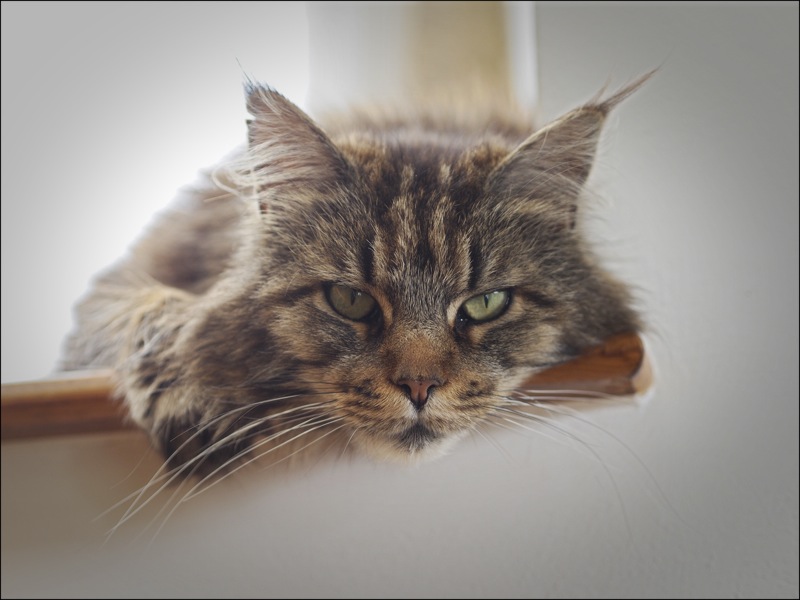
I’ve seen that wry smile on a colleague’s face when I tell them how it feels to lose a pet . Not that Soph was a ‘pet’, she was a fiercely beautiful but barely tamed Maine Coon cat who viewed the human race if not quite the enemy, certainly as all potential vivisectionists. But those who don’t understand how attached you can become to an animal are simply embarrassed by our tears; they don’t know what to say. Statements like ‘well you can always get another one can’t you?’ are unhelpful. Yes, I have another cat, but he isn’t her. He is different. I will probably have a few more in my life (or rather they will have me) but each one I have lost has left a unique shaped space behind in my heart that another will eventually fill- but not in quite the same way. Some colleagues of mine have written about the important part that animals play in providing support for people with long-term conditions. But we live in a society where older (and younger) people with mental health problems are regularly separated from their companions when they have to move into new rented accommodation due to the desperate state of our housing policy. I cannot imagine the pain of having to give up my companion animal. Perhaps I will have to one day.


Grief is something I know about. I treated many people in my career who were failing to grieve for someone, or something they had lost. It doesn’t have to be a person, it can be a career, a person, your health, or even your hopes for the future. The list is endless. The process IS normal but it can be frightening if you have never felt it before. It isn’t the same as depression although if a person fails to grieve properly depression may follow, and in the vulnerable, loss may trigger it. But it should not be medicalised as it has been in DSM-5 where two weeks of depressed mood following loss is taken to indicate depression. Two weeks? That’s crazy. Grief can take years, a lifetime to resolve. The key thing is the trajectory of the process and the severity of the symptoms. Is it gradually getting easier over time or unchanged in intensity? How low are you feeling? Have you had thoughts of suicide or wanting to join the dead person?  I failed to grieve successfully once when I lost someone very important.  I didn’t talk about it. I tried to work my way out of it at the hospital rather than go through it.  You cannot shut it out. You have to talk, remember …and weep.


Sophie was killed by a fox one night in August. She loved going out at night to hunt. She began her life as a pedigree puss and then heard the call of the wild. She escaped when she got very frightened as were taking her to a cattery and wriggled out of her harness. She would never travel in a cage. I missed her terribly but I always hoped she come back to us, and she did. She spent two years living rough before she finally trusted a lady enough to accept help, and was returned to us (due to her microchip) by the RSPCA. She would sit next to me on the sofa and purr loudly, demanding her share of my love. Her coat was soft and silky before she disappeared, but woolly and thick when she returned after two winters outside in Yorkshire. But she knew she was home and she embraced it with enthusiasm. She was a happy, healthy cat and she was only seven years old. It’s really hard to accept she could have survived so long on her own and then die now. But I couldn’t have kept her inside. That would have been unbelievably cruel.  Yet I still feel I should have been there to protect her. Grief isn’t just about sadness, but guilt and anger. And remembering.

I have some of her fur, and a library of pictures to remember her by. I can look at them now. It was very painful at first.

It’s getting a little easier each day.  That I’ve been able to write this is a sign I’m coming through it.

But I’ll always miss her.


Taking the tablets

I’ve been putting off writing about this topic. Even though I know it is something I really should talk about. I’ve used the excuse of the failure of British Telecom to sort out my intermittent broadband connection, which can be real a problem living alone on an island. But I cannot avoid it any more. So I am going to say what I think about antidepressants.

In the spirit of presenters at the American Psychiatric Association currently taking place in New York, let me begin my presentation with a few disclosures, so that you are fully aware where I am coming from:

I am a psychiatrist.

I don’t practice now, I’ve retired, but throughout my entire professional life I prescribed antidepressants regularly.


I have spoken at meetings funded by pharmaceutical companies and they have funded a couple of small research projects for me over the last two decades.

Neither my talks, nor my research have been promotional. I’ve never been involved in any research trial of a medication. At meetings I’ve generally been the acceptable psychosocial meat in the biological sandwich- squashed between presenters talking about the latest research into the biology of depression, much of which I’ve had a great deal of difficulty really understanding, even as an academic.

Last, but not least, I’ve taken antidepressants for most of the last 25 years. I’ve been continuously on them for 20.

My treatment record reads a bit like a history of the pharmacology of depression- and the promotion of antidepressants. Tricyclics (dosulepin), SSRIs (paroxetine and fluoxetine), SNRIs (venlafaxine and duloxetine) and adjunctive therapy (Lithium) with some antipsychotics thrown in.

So those are my disclosures.

What can I say about the rights and wrongs of taking medication?

First of all, just that: It is neither right nor wrong. I number among my friends people who will not take medication, and others who do. I don’t try and impose my view on them. Neither do they try and do that to me. It’s a matter of personal choice. But I hope it’s a fully informed choice when you make it.

Secondly: I dislike a great deal of what is written in the press about medication, because it often diminishes my experience of both having personally benefited from it and of seeing many of my most severely depressed patients do so too. Suggestions I would be harmed by it (which I haven’t been, though I’ve certainly experienced a great many side effects and had to withdraw from Seroxat- so I know about withdrawal symptoms) have proved incorrect. Some of the items in the media of late diminish the whole experience of severe depression by telling me everything can be solved by my going out for a run (radio 4 today) or taking up gardening.

Thirdly: Just because I’ve taken medication it doesn’t mean I haven’t had episodes of depression, but they haven’t been as severe as they were before I went on it. They are certainly not ‘happy pills’. I wear black most of the time and my friends will tell you I am not known to be pathologically over-cheerful. My mood dips, usually in response to how I cope with life events, and when I’m on medication it rights itself a little faster, but at least it bounces back. It used to take a lot longer, and I would get much lower, when I wasn’t.

Fourthly: Even Skeptics will acknowledge there is some evidence for antidepressant medication in severe depression. My approach clinically was always to work through the advantages and disadvantages of particular treatments and add my own opinion. As an expert, my patients expected me to have one. But the choice was theirs. If they were severely depressed, I’d ask that they not completely dismiss medication as an option, but to hold it in reserve for a while. I would do all I could to help them with their preferred option first. But if that didn’t work could we re-evaluate the decision at a later date?

Fifthly: Medication has its risks as well as its benefits. There are no easy options when your mood is very low. Side effects can be awful, and there are situations in which antidepressants should be used with extreme caution. Especially in younger and older people. A combination of venlafaxine and lithium gave me a prolonged Q-T interval in my ECG, which in lay terms means I had a greater than average chance of dropping down dead. I recovered on it, but it had to be stopped.

Sixthly: there is no place for the use of medication alone. Most people get depressed because they have problems, and if they don’t have them before they get down, persistent depression will cause them. It’s difficult living with a person with chronically low mood. Our physical health suffers too. We cannot work.

Talking of one form or another is an essential accompaniment to medication; anything on the broad spectrum from an honest and open conversation with a GP who listens to you and provides continuity of care to a longer term psychological therapy to help deal with some of the issues which increased your vulnerability to depression in the first place. Whatever is most appropriate and needed at the time.

Lastly: If the life events and problems which originally contributed to your depression have not resolved, you may benefit from staying on medication. Not everyone is able to make the changes in their lives that are needed to stay well. I’ve spent my life working in places where people lead very tough lives. There is nothing to be ashamed of in staying on medication, and I’ve argued the point with GPs who wanted to ‘wean’ patients off tablets prematurely. (Weaning is such a demeaning and unwarranted term anyway- it suggests a degree of infantilism).

I don’t know what would have happened if I hadn’t taken medication, but I can tell you things were not looking very positive. There are times when engaging in talking therapy is very difficult. When you feel as though there is a weight pressing down on your chest, making it very hard for you to breathe or carry on. The idea of going out for a run….well….need I say more? It feels impossible to be sure of your next breath. Antidepressants helped me to get to a point where I could use psychotherapy effectively. I’ve been able to keep going, write, research and hopefully help others. So I cannot put off honestly saying what I think and hope you will listen.

That’s all I can ask for.

On not being immortal

When I was a medical student, I remember one ward round when we were gathered around the bed of a patient who was breathless and coughing up blood. She admitted to being a heavy smoker. The surgeon gave her his usual stern ticking off about the dangers of cigarettes, and then we all trooped back to the doctor’s office where he took the patient’s chest x-ray out of the envelope and pushed it up onto the light-box on the wall.

“Look at the mass there he said,” pointing to dense shadow in the left lung, “almost certainly a carcinoma.”

And then he calmly took a packet of Senior Service cigarettes out of the pocket of his white coat and lit one up, puffing away as we discussed the prognosis. You have to understand this was the Stone Age.  People did still smoke in hospitals, even doctors. But some things haven’t changed. I think many doctors still have a peculiar belief in their own immortality. That knowing all about disease not only gives you power over it but makes you immune to it. It begins at medical school. Many medical students aren’t even registered with a GP where they go to university. They alternate between being sure they have every disease they learn about and denial of their own susceptibility. And it carries on. Doctors generally don’t smoke now, but we still abuse ourselves in other ways, notably with alcohol. We are tough and macho, don’t admit to weakness, and rarely follow the advice we give our patients, yet expect them to wholeheartedly agree with us.

Last year I had to come to terms with the fact that I’m not going to be immortal after all. I don’t mean that in the sense of transcendence of my soul.  I’ll keep out of that argument for the moment.  Rather I am not going to live forever, and life might get quite a bit harder for me physically in the future than it is now. To add to the anxiety, depression and hypothyroidism, I was diagnosed with progressive kidney disease.

Okay, so I know I will not live forever. Of course I won’t. Indeed would I really want to? There have been times when I’ve been so depressed that I’ve wanted to end my life somewhat sooner. The thing about depression for me, unlike physical illness, is that it feels like if I were to die from it, it would be because I wanted to. I have control. Even though I know rationally, as a psychiatrist, that what I perceived I wanted would be strongly influenced by my mental state at the time.  But there is, I think, a part of all of us that secretly hopes we can cheat fate and carry on forever (only while enjoying of course the perfect health of youth). When I was a young child, the idea of dying seemed so impossibly far away as to be almost irrelevant to being alive. Then my grandfather died followed by my father, both at ages not so different from where I am now. When people close to you die, death became a real possibility for you too.

People who have chronic illness are more likely to experience depression and anxiety, and the more chronic illnesses you have the greater your risk. In the last research project I worked on in Manchester, we attempted to offer psychological therapy to people with diabetes and/or heart disease who were also depressed. What was striking was how few of these people were actively receiving help despite the fact that all them had been screened for depression on an annual basis as part of the payment incentive system for GPs in the UK. Some of them had never discussed their mood or suicidal ideas with their doctor. They didn’t want to, they were embarrassed or they didn’t see the point, so they suffered in silence. It can feel stigmatizing having chronic illness, and having a mental health problem as well just doubles the stigma.

So it turns out I have a genetic disorder of the kidneys that I’ve had for many years, but didn’t know about before, and which is going to get worse as I get older, at a rate as yet undetermined. There is a good chance I will eventually need to have dialysis. Despite feeling fitter than I have for years, it is as though my body has let me down. Something is happening inside me over which I have no right of determination. Like many people with chronic illness I feel my useful life has now become shorter, so I’m beginning to speed up my rate of travel, picking up again those things I started to do many years ago but dropped because of my career, and aiming to achieve a few of them while I’m still quite healthy. Not quite a bucket list but something similar. It has increased my level of anxiety but I don’t feel depressed about it yet because I’m still in control, trying to keep myself fitter than I have since – well ever.

Or maybe it’s because I’m just being tough…. and I still believe I can win.

The healing power of the sea

I’m on the coast of North Yorkshire this week weathering a storm. I can hear the waves lashing the sea wall below my window. It’s different from the storm I would be facing if I were still at work, having to face the reality of providing care for people with mental health problems when services are being so constrained. While I listen to the windows rattling and watch the water rising up the slipway at high tide I find myself dipping into twitter every now and then. I can sense my blood pressure rising as I follow the debate about whether it is actually possible to achieve parity of esteem with physical care for people with mental health problems when everything is being cut. In some ways I miss work, particularly for the sense of being able to make a difference and for the contact with my patients. In other ways, for the constant anxiety it evoked in me for so many years, I don’t miss it at all. I’m still writing, and involved in research and teaching but I have control over what I do each day. That sense of having control over your life is important when you experience depression.

The sea can be both a source of fear, and of great comfort. I grew up next to it, and it evokes powerful memories of my childhood. My father was an excellent swimmer, but however hard he tried he never succeeded in teaching me. I was simply too anxious to take my feet off the bottom. I didn’t entirely trust he would not let go of me, yet now those times when I sat on the beach and watched him powerfully crawling through the waves off the Lincolnshire coast are some of the fondest memories I have of him.  I was born a couple of years after the great flood, which devastated the East of England. Since then I’ve travelled all over the world but have always felt the need to dip my toes in the water of whatever ocean I find myself beside. It’s like touching base with the past.

I cannot begin to imagine what it is like to be swept away in a tsunami, have your home battered by tidal waves or lose your husband when a fishing boat goes down with all hands. I’ve stood in the waves on Copacabana beach in Rio, and felt the warm tropical current try and drag me down into the depths. I’ve been unable to go into the shallows in Queensland for fear of being attacked by box jellyfish and sharks. The ocean is immense, merciless and can be so destructive, and yet it connects us all together. It has a power over which we can have no control; we have to accept it.

When times are bad the sea has a way of helping me to get my problems into perspective. I came here once, to the place I am now in Yorkshire, when an intense relationship that meant everything to me had broken down. Listening to the sound of the waves pounding the walls below as I lay in bed, with only the moonlight shining through the curtains illuminating the room, both resonated with my mood and helped me to understand how life goes on whatever happens.

Some years ago when I was on a beach in the Pacific Rim Park on Vancouver Island in Canada, I saw a woman meditating whilst sitting on a driftwood log next to the ocean. Since then, I’ve always taken the opportunity to use the sound of the waves to help me to clear my mind and relax whenever I am in earshot of the sea.  Next time you are there, whatever the weather happens to be, find somewhere to stand or sit awhile that is sheltered from the wind (or rain). Focus on your breathing as you would in any kind of meditative practice, but listen intently, with your eyes closed, to the sound of the waves ebbing and flowing and crashing to the shore. Try and carry on for at least ten minutes or longer if you can. When I make time to do this, it gives me a wonderful sense of wellbeing. For me it’s a kind of meditation in which I connect directly with nature. I suspect it’s a similar feeling to that achieved by mindfulness practice, but I am only just making time now to learn more about that. I will write more on that topic soon. In the meantime I am returning home with the sound of the sea, not in a shell in my pocket as I did as a child, but in my soul instead.