
Addendum to ‘Three times more common in women.’

I promised I would reply to the comments on this blog which were posted on X, mostly by psychotherapists working in the USA, so, after a holiday and an intensive week of public events (conducted from my desk in Orkney whilst wearing my slippers) here we are.

In response to Mark Ruffalo’s comments about the ‘Borderline Wars’ which prompted the discussion I can only say that debate does continue, as does research and psychiatric science is always evolving and modifying our views of the world – as it should do.  My views have changed over my career in response to listening to the stories of many, many women who have received the diagnosis, but I still found the observations and insights provided by reading the great psychoanalytic researchers in the field very helpful in my work. Although I disagree with Peter Tyrer’s view that diagnosis of personality disorder should be broadened – in fact I’d much prefer to limit it very considerably – his work on ICD-11 brought together world experts in the field and they arrived at somewhat of a compromise to still include the ‘borderline pattern specifier’. He notes in a recent review in World Psychiatry:

‘The features of borderline personality disorder are not traits, but symptoms and fluctuating behaviours, and – like many symptomatic conditions – improve steadily over time. When borderline symptoms are examined in factor analytic studies, they are scattered over a range of both personality and other mental disturbance and have no specificity’. All attempts to find a borderline trait have failed. While borderline symptoms appear coherent when examined in isolation, they disappear into a general personality disorder factor when modelled alongside other personality disorder symptoms.’

            I’d recommend this open access article to anyone interested in a different perspective on ‘borderline’. I realise it contrasts with that held by many therapists, especially in the USA (hence the inclusion of the ‘borderline pattern specifier’).

            I’ve questioned why the diagnosis is more common in women. I certainly agree that more men get diagnosed with anti-social personality disorder, and many of them are indeed in prison. But I suspect some men are also more likely to get diagnosed with cPTSD instead? Do we know? Women with the diagnosis of BPD are also overrepresented in the prison population too, (including some that are frankly misdiagnosed – which is certainly a major problem as I’ve discussed in the blog). Women are more likely to seek help for mental health problems, but I do think we need to consider, (as someone commented but I can no longer find their post!) how much the criteria used to diagnose BPD reflect emotions and behaviours that are more associated with women in extreme distress.  I also really appreciated the comments about the menstrual cycle, which affects and colours just about all mental health problems that women experience, not just those given a diagnosis of BPD.

It’s very difficult for me to know how different care is for those diagnosed with Borderline Personality Disorder across the Atlantic. Reading Laura Delano’s book Unshrunk includes a description of her care under John Gunderson at McLean Hospital and has been fascinating in many ways (review to come). Such residential care with intensive therapy has, as far as I’m aware, pretty much disappeared now from the UK, but I’d be interested to hear whether this is true.

 Awais Aftab, in his review of Out of Her Mind, has said, in response to my views about BPD that:

 ‘In a system where such attitudes are pervasive, it is easy to see how one would conclude that misogyny is baked into the very concept of BPD. Working as a psychiatric clinician in an entirely different health care system in a different country with a different patient population whose experiences with the diagnosis are more favorable, I can afford to say in return that it is more complicated than that.’

I really appreciate his different perspective but would like to know what happens to those in the USA given this diagnosis, especially women, without access to the kind of expertise that families or good health insurance can purchase. And elsewhere around the world too.  What do they think of the care that they receive?  

Listening to women’s experiences has been key for me, which is why why Out of Her Mind is so full of women’s stories.

Three times more common in women

Women are three times more likely to be diagnosed with borderline personality disorder (BPD) than men. That fact alone should give you pause for thought. 

Yet when I read the endless academic papers and discussions about the proposed causes of and treatment for BPD, (sometimes still called emotionally unstable personality disorder or EUPD), especially those from the psychoanalytic community in the USA, the question ‘why?’ never seems to arise. It is a ‘complex interplay of genetics, biological factors, trauma, abuse, neglect and pathology of attachment’. But isn’t that true, more or less, for many of us with mental health problems? I say this as someone who has in the past been told I have ‘borderline traits’ (by someone who was reviewing my first book, The Other Side of Silence, on Amazon).  My personality has certainly been influenced by all of these factors, as have those of a great many of us. That doesn’t mean I think we all have personality disorders (which is the direction that ICD-11 has taken us in). Rather like if ‘everything is trauma’ then it follows that nothing probably is, for me the same is true of personality disorder. We are all complex individuals and some of us are far more capable of managing interpersonal relationships than others, depending on many things but particularly the interplay between our early experiences, temperament (which is inherited) and (sometimes traumatic) life events. But that shouldn’t make us ‘disordered’.

Forty years ago when I was training in psychiatry, and hoping to become a psychoanalytic psychotherapist, I was first introduced to the ideas of the great American psychoanalytic thinkers, Heinz Kohut, Otto Kernberg and John Gunderson. I do appreciate their massive contribution to understanding and working with people who have great difficulty in relating functionally to themselves and others. I listened to the legendary British psychotherapist Anthony Ryle in the spring sunshine in garden at a society for psychotherapy research meeting in Ravenscar sometime in the late eighties as he diagrammatically reformulated borderline personality disorder, with his ‘broken egg’ diagram and realised how I had felt many times as though I was stuck between the sharp edges of the egg shell not only as a therapist, but also as a person and a patient. Because I was in therapy too over several years, trying to manage my own difficulties with a persistent depression that was undoubtedly influenced by that complex biopsychosocial morass of factors that both moulded my personality, and resulted in my problems with my mood and my relationships.  For decades I was professionally and personally aware of the overlap between ‘borderline’ symptoms and many other diagnoses, particularly mood disorders. If aspects of our personality contribute to us both experiencing and having difficulty recovering, we need psychotherapy and should be able to get this without being diagnosed with personality disorder. Something I wrote to the NICE guideline committee about with no success.

But, even though later, as a clinical academic general psychiatrist (I decided against becoming a psychotherapist and went into academia) I wrote and taught about personality disorder, I was aware that ‘borderline’ was diagnosis that I almost never personally used. In later years I’ve found the words of George Vaillant the veteran American psychiatrist particularly cogent, ‘The beginning of wisdom is never calling a patient borderline.’ In his paper Vaillant, who followed people up over many years for his research into personality, talks about ways to help those who use problematic defence mechanisms to cope. People who had experienced difficult lives. He calls their defences ‘immature’ but they are very common ways of coping, and I have met them often in my work in mental health, amongst my colleagues as well as my patients. Vaillant says: ‘I believe that almost always the diagnosis “borderline” is a reflection more of therapists’ affective rather than their intellectual response to their personality-disordered patients’, the powerful impact of the countertransference – that the patient has on the therapist. He also talks, as do others such Peter Tyrer, of the considerable symptom overlap with other diagnoses. In British psychiatry “Borderline’ has become an insult applied to many women too often without any adequate assessment of what their problems might be. This now applies to the umbrella term ‘complex emotional needs’ which Hat Porter and their colleagues rightly call a new pseudo-diagnosis that ‘risks further legitimising the personality disorder construct and broadens its scope, therefore widening the prejudice, discrimination and neglect associated with the label.’

I’ve spoken to some who find the diagnosis useful to understand their way of relating to the world, and sadly to obtain therapy (accepting it seems to be required by some therapists). But I have met so many others in the world, during my research for Out of Her Mind, and on Mad Twitter who have not, and have suffered terribly – even been excluded from care altogether.

            But why is it so commonly applied to women? First of all, I’ve no doubt that many women given this label are misdiagnosed and may have PTSD, bipolar disorder, Premenstrual Dysphoric Disorder or be neurodivergent, but have simply not been listened to. Secondly, people who get the label BPD are overwhelming likely to have experienced complex trauma and have experienced childhood adversity which we know is more common in women. How many women who are subject to repeated sexual violence end up with this label? And, as Jay Watts say in her recent paper ‘who gets to be a victim’ determines whether the cPTSD (complex posttraumatic stress disorder) diagnosis is given (which I’ve witnessed in practice), or BPD. Sometimes it’s even both. cPTSD was intended as a kinder label but “Paradoxically, the introduction of cPTSD has reinforced the seeming validity of BPD, as direct comparison often does.” Helping someone doesn’t require acceptance of the label. Therapies researched for BPD do work for cPTSD and perhaps it’s time we took a transdiagnostic approach, working in collaboration with the patient to consider with them what is needed to help them, be it help with emotional dysregulation, mentalisation, processing trauma, or other ways of coming to terms with living in the world. I benefited greatly from psychodynamic therapy so I am biased, but I do know that the sense that my therapist believed in me, and didn’t see me only as a ‘difficult woman’ was crucial.

Yet, mental health professionals seem to find it a label they want to continue to apply especially to ‘difficult’ women, including those who fail to recover from depression or eating disorders as fast as they ‘ought’ to do and especially those who self-harm. I have sympathy with the feminist view that the ‘symptoms’ of BPD are remarkably like the way that women simply cope with extreme emotions. That it is inherently misogynist.  In some ways ‘complex emotional needs’ echoes this – how many women have been told they are ‘too needy?’ I was, many times, in my younger days. 

We must begin to consider in greater depth how women with serious mental health problems which are not ‘psychotic’ (which tends to be the focus of care) are being assessed, diagnosed and helped, or not in mental health systems. Just because ‘this is how we’ve always done it’ or ‘we have specialist units set up for excellence in BPD’ are not good enough reasons to avoid change (except of course for accountants). 

Read about my latest book: Out of Her Mind: How we are failing women’s health and what must change

Ambivalence

I wish they had taught me about ambivalence at medical school. It would have made my life immeasurably easier if I had understood it earlier. Instead I was quite a long way into my career before I really began to see how important it was both to my patients, and to me personally.

I was taught what to do for each clinical problem with the expectation that a person would be ready, and willing, to accept my advice. If he or she wasn’t, they were something of a nuisance, indecisive, unable to recognise what was good for them. ‘Oh she’s ambivalent about it,’ I would be told if a person was shilly-shallying around. Ambivalence as a concept was confused with indecision. But it isn’t. It’s something much more than that. It’s about wanting to have something at the same time as not having it. Wanting to be thin, but to eat a large slab of chocolate every day.  Wanting both the benefits of sobriety and inebriation. Even wanting to be both dead, and alive at the same time. I know from talking to people who have tried to kill themselves and failed, that they sometimes wanted to be both still here among the living, yet dead and out of their suffering too. Some of them changed their minds as soon as they had acted to end their lives and came to seek help. Ambivalence underpins so many of the problems people have brought to me, and my own difficulties too. I was an ambivalent medical student, and for many years an ambivalent doctor. I wanted both to belong to a profession and all the benefits that come with it, and not to belong because of the cost to me personally and emotionally.

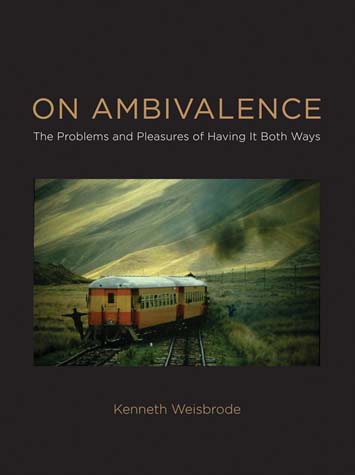
If you haven’t read Kenneth Weisbrode’s recent short book on the topic, entitled ‘On Ambivalence’ I can highly recommend it.

‘Ambivalence lies at the core of who we are. It is something more subtle, and more devastating than human frailty. Weaknesses can be remedied. Ambivalence comes, rather from too much ambition. Desire begets dissatisfaction, and vice versa. Optimization becomes a fetish. Wanting the ‘best’ means that we must have both or all and are reluctant to give up any option lest we pull up the roots of our desire. That is why ambivalence is so hard to confront, understand. Or master. And why it can be so disastrous.  Most of us know this. Yet we continue to deny it.’ (p2)


9780262017312

The person who is ambivalent about their eating, or drinking, or lifestyle ( add ad infinitum) is not only unable to choose the from the options they have in front of them, but refuses somehow to admit that there is even a choice to be made at all. It’s both a painful yet oddly pleasurable place to be. We cannot have it all, but still somehow  want to believe that we can. We don’t have to decide what to do, to change our lives, because there isn’t a decision to be made. Yet we suffer because we struggle to live what is an impossible existence, only we don’t admit how impossible it really is.

If I had understood this when I was younger, I might have been able to recognise how much suffering is rooted in ambivalence. I began to understand it when I worked in addictions, and later with people who had eating disorders.  I’ve talked to many people who have felt judged rather than helped by those they have consulted; who have been labelled as weak because they are unable to ‘choose to change their behaviour’, rather than essentially ambivalent about life and what they wanted from it. I was influenced by Bill Miller, who first described Motivational Interviewing in the 1980s. I remember reading about how the clients of the clinic where he worked were routinely asked if they were willing to accept the label of alcoholism and accept treatment. That was exactly what I witnessed as a junior doctor:

Consultant: ‘So do you think you are an alcoholic?’

Patient : ..’No… I don’t’

Consultant: ‘Are you prepared to attend AA?’

Patient: ‘Why would I want to do that.?’

Consultant: ‘Well, if you aren’t prepared to admit that, you aren’t motivated to accept help. Come back again when you are.’

We may say it doesn’t happen quite like now, but it does. A person who doesn’t see the need to make a decision about taking up therapy and attends only intermittently is rapidly discharged for being unmotivated.  Instead of trying to understand their ambivalence and empathising with the problems they are experiencing which make it impossible for them to contemplate a decisive response to their problems, we treat them as wasting our time. When he first described Motivational Interviewing, Miller emphasized the responsibility of the therapist in helping the client to acknowledge and explore their ambivalence. When the person is ‘unmotivated’ we are discharged, as therapists, from our responsibilities.

I was personally fortunate. I had a therapist who was prepared to engage me in acknowledging that I both wanted to succeed and to fail in my career, and ultimately to both to live and to die. I’m still ambivalent, but I don’t want to talk about that now. There isn’t time. My cat is currently driving me crazy, wanting to be on both sides of the back door at once. Now that’s ambivalence.